Saudi Arabia tourism statistics: 2025 numbers, hotels and the 2030 goal
How many tourists visit Saudi Arabia, where they come from, why they travel, how full the hotels are and how far the Kingdom is from its 2030 goal. Official Ministry of Tourism figures, our analysis and a free CSV with the source of every number.
 The Khaleej SEO team
Published · Updated · 9 min read
Key finding: Saudi Arabia recorded 122.6 million tourists in 2025 (up 5.8% on 2024): 93.3 million domestic and 29.3 million inbound from abroad, according to the Ministry of Tourism’s Annual Statistical Report 2025, which news reports round to “around 123 million”. Against the 2030 goal, the Kingdom has already passed the domestic half and is far from the international half. In 2025 it recorded 93.3 million domestic tourists against a goal of 80 million, but 29.3 million inbound tourists against a goal of 70 million. At 41.9% of the way there, inbound tourism would need to grow about 19% a year to 2030. In 2025 it fell 1.6%.
The figures below come from the Ministry of Tourism’s Annual Statistical Report 2025, released on 18 June 2026, the ministry’s data series published on the DataSaudi platform, and Saudi Press Agency releases quoting the ministry. Every number links back to its source in the methodology section and in the free CSV.
Saudi tourism at a glance
| Indicator | Value | Source and period |
|---|---|---|
| Tourists, inbound and domestic | 122.6 million (up 5.8%) | Ministry of Tourism, 2025 |
| Inbound tourists | 29.3 million (down 1.6%) | Ministry of Tourism, 2025 |
| Domestic tourists | 93.3 million | Ministry of Tourism, 2025 |
| Tourism spending | SAR 303.7 billion (up 7.0%) | Ministry of Tourism, 2025 |
| Inbound spending / domestic spending | SAR 176.6 billion / SAR 127.1 billion | Ministry of Tourism, 2025 |
| Hotel occupancy | 55.8% | Ministry of Tourism, 2025 |
| Average daily rate, hotels | SAR 449 (excluding VAT and municipal fee) | Ministry of Tourism, 2025 |
| Jobs in tourism industries | 1.03 million | Ministry of Tourism via SPA, 2025 |
| Tourism direct share of GDP | 4.9% | Ministry of Tourism via SPA, 2024 |
| Tourists, first quarter (revised preliminary) | 34.9 million | Ministry of Tourism, Q1 2026 |
How many tourists visit Saudi Arabia?
In 2025 Saudi Arabia recorded 122.6 million overnight tourists: 29.3 million from abroad and 93.3 million Saudi citizens and residents travelling within the Kingdom. Domestic travel is three quarters of the total, and it is the part that keeps growing.
| Year | Inbound tourists | Domestic tourists | Total |
|---|---|---|---|
| 2019 | 17.5 million | 47.8 million | 65.3 million |
| 2022 | 16.6 million | 77.8 million | 94.5 million |
| 2023 | 27.4 million | 81.9 million | 109.3 million |
| 2024 | 29.7 million | 86.2 million | 115.9 million |
| 2025 | 29.3 million | 93.3 million | 122.6 million |
Source: Ministry of Tourism annual series on DataSaudi (overnight tourists by type). Totals may differ by 0.1 million from the sum of the columns because of rounding.
Against 2019, domestic tourism has almost doubled (up 95%) and inbound tourism is up 67%. But the two lines split in 2025: domestic tourists grew by 7.2 million while inbound tourists fell by about half a million. The split continued into 2026. The ministry’s first release for the first quarter (8 April 2026) showed 28.9 million domestic tourists, 16% more than a year earlier, while its revised preliminary figures (26 July 2026) put the quarter at 34.9 million tourists in total and SAR 84.4 billion in spending.
Saudi Arabia against its 2030 tourism goal
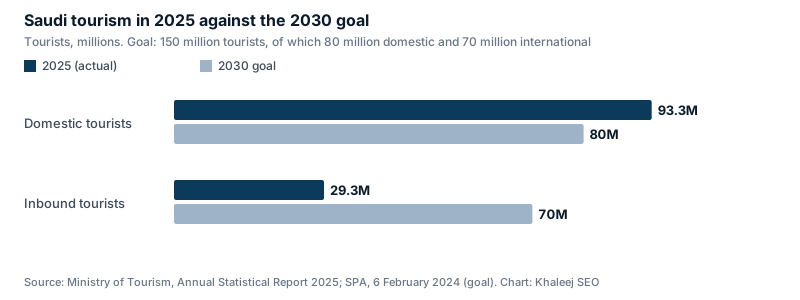
The Kingdom first set a goal of 100 million tourists by 2030 and announced that it had reached it in 2023. In February 2024 the Minister of Tourism described the new strategy as 150 million tourists by 2030: about 80 million domestic and 70 million international. In February 2026 he repeated the 150 million figure.
Measured against that split, 2025 looks like this (Khaleej SEO calculation):
- Domestic: 93.3 million, already 116.6% of the 80 million goal, five years early.
- Inbound: 29.3 million, 41.9% of the 70 million goal. Closing the gap by 2030 means about 19% growth every year, against a 1.6% fall in 2025.
- Total: 122.6 million, 81.7% of 150 million. Only about 4.1% growth a year is needed to reach the headline number, which is why the total can arrive on time while the international part does not.
For hotels, tour operators and destination marketers, the gap is the story: most of the growth that is left to win is international travellers who have not yet chosen Saudi Arabia.
Why tourists come: religion, leisure, business and family
| Purpose | 2019 | 2024 | 2025 | Change |
|---|---|---|---|---|
| Religious | 9.9 million | 12.3 million | 14.1 million | up 14.5% |
| Leisure | 1.1 million | 7.5 million | 7.0 million | down 6.2% |
| Friends and family | 2.7 million | 6.0 million | 4.4 million | down 26.5% |
| Business | 3.2 million | 2.0 million | 2.3 million | up 13.9% |
| Other | 0.7 million | 2.0 million | 1.5 million | down 24.8% |
Inbound tourists by main purpose; change is 2025 against 2024. Religious covers Hajj, Umrah and visiting Madinah, and friends and family means visiting friends and relatives.
Source: Ministry of Tourism series on DataSaudi; changes are Khaleej SEO calculations on the unrounded figures.
The ministry’s own headline is that non-religious purposes made up about 52% of inbound overnight visitors in 2025, against 44% in 2019. Leisure travel from abroad is now more than six times its 2019 level. What the headline does not show is the direction in 2025 itself: on the ministry’s series, the non-religious share was 58.5% in 2024, and in 2025 religious trips grew by 1.8 million while leisure and family visits fell. Inbound tourism dipped in 2025 because non-religious travel shrank, not because pilgrims stayed away.
Domestic travel is a family story. Visiting friends and relatives became the largest domestic purpose in 2025 with 37.7 million trips, ahead of leisure at 30.2 million. Domestic leisure trips have fallen two years running, from 35.0 million in 2023.
Where inbound tourists come from
Egypt was the largest source market in 2025 with 3.2 million tourists, followed by Pakistan with 2.8 million and India with 2.0 million. Pakistani tourists spent the most of any market, SAR 22.0 billion. Indonesia, the UAE, Iraq, Kuwait, Bahrain, Turkey and Yemen complete the top 10, which together supply 61% of inbound tourists and 56% of inbound spending.
By region, Asia and the Pacific supplied 36% of inbound tourists and 47% of inbound spending. The Middle East and North Africa followed with 8.8 million tourists. The two moves to watch run in opposite directions: tourists from other GCC countries fell 28.7% to 5.7 million, while arrivals from Europe rose 17.8% to 2.9 million and their spending rose 20.6%.
How long tourists stay and what they spend
Inbound tourists spent SAR 176.6 billion in 2025 and domestic tourists SAR 127.1 billion. The ministry’s dashboard puts the average inbound trip at SAR 5,991 and the average domestic trip at SAR 1,356.
The inbound trip itself has changed shape. The average stay grew from 9.8 nights in 2019 to 18.9 nights in 2025, while spending per night fell from SAR 544 to SAR 316. Visitors stay about twice as long and spend less each night, which fits a mix that leans towards pilgrims and long family visits.
Hotels are where the money goes. 65% of inbound tourists, 18.9 million people, stayed mainly in hotels in 2025, and they spent SAR 133.1 billion, an average of SAR 7,027 per trip.
Hotels: occupancy and room rates
Hotels in Saudi Arabia averaged 55.8% occupancy in 2025, up 1.2 points on 2024; apartments and other accommodation averaged 53.7%, and all facilities 55.3%. January was the busiest month at 63.4%. The average daily rate was SAR 449 in hotels and SAR 385 across all facilities, excluding VAT and the municipal fee, with May the most expensive month at SAR 691 across all facilities.
The first quarter of 2026 started stronger: the ministry’s April release gave preliminary occupancy of 59%, with Madinah at 82%, Makkah at 60% and Jeddah at 59%, and around 10 million domestic tourists over the Ramadan and Eid al-Fitr school holidays, 14% more than a year earlier.
By province, the 2025 report puts occupancy in licensed hospitality facilities highest in Madinah at 73% (up 5 points), followed by Riyadh at 62% (down 4 points), the Eastern Province at 55%, and Makkah and Najran at 52%. Al Baha was the lowest at 36%, a gap of 37 points to Madinah. Riyadh Province alone recorded 24.3 million visits and SAR 49.0 billion in tourism spending in 2025.
When hotels fill up, region by region
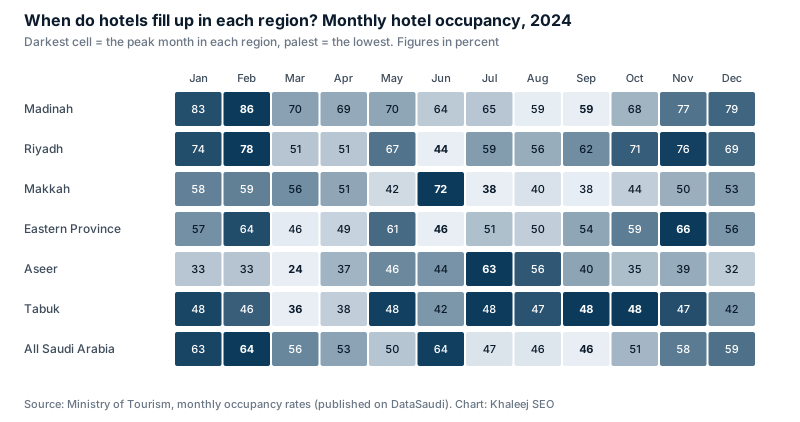
Every region fills up in a different month. In the ministry’s 2024 monthly series (the latest complete year by province), Riyadh’s hotels peaked in February at 77.5% and fell to 43.6% in June. Makkah peaked in June at 71.6%, the Hajj month, then dropped to 38.0% in July. Aseer, the summer mountain destination, peaked in July at 62.6% and bottomed at 24.4% in March. The Eastern Province peaked in November at 66.2%, and Madinah stayed above 58% all year with a February high of 85.8%. Card payments tell the same story for Aseer: Abha’s share of Saudi point of sale spending in July was 138 to 148 where 100 is its yearly share, in each year from 2021 to 2025 (see Saudi card spending by city).
The gap between a region’s best and worst month is large: 38.2 points in Aseer, 33.9 in Riyadh and 33.6 in Makkah (Khaleej SEO calculation). A hotel that plans its marketing on the national average plans for a month that does not exist in its own city. For hotels in the capital, our SEO agency in Riyadh page covers hotels, serviced apartments and travel companies.
Tourism in the Saudi economy
Tourism contributed 4.9% of GDP directly in 2024, and that contribution grew 14% in value on the year before; the ministry’s flash estimate for 2025 is 5.2%. The minister has described the target as 10%. Tourism industries employed about 1.03 million people in 2025.
In the balance of payments, travel exports (spending by inbound overnight visitors) reached SAR 159.9 billion in 2025, and the travel account ran a surplus of SAR 49.4 billion, more than 61% of total services exports.
Where the sources disagree
- 123 million or 122.6 million? The press release rounds the 2025 total to “around 123 million”; the report itself prints 122.6 million. Both describe the same count.
- The 2023 figure was revised. In February 2024 the ministry announced 100 million tourists for 2023 (77 million domestic, 27 million international). The ministry’s current series on DataSaudi gives 109.3 million for 2023 (81.9 million domestic, 27.4 million inbound). Use the current series for comparisons.
- Inbound spending is measured twice. The report gives inbound tourism spending of SAR 176.6 billion and balance of payments travel exports of SAR 159.9 billion for the same year. They follow different definitions; quote one or the other, never the difference as a finding.
- The first quarter of 2026 has two versions. The April release gave 37.2 million tourists and SAR 82.7 billion; the revised preliminary figures of 26 July 2026 give 34.9 million and SAR 84.4 billion. We use the revised figures.
- Tourism’s share of GDP in 2019. The minister said 3.5% in February 2026; the ministry’s report shows 3.6%.
- Overnight only. All tourist counts on this page are overnight tourists. Same-day visitors are not in them, and GASTAT counts Umrah performers in a separate series with its own definitions.
What this means for hotels, tour operators and travel agencies
- The open market is international. The domestic goal is met; the inbound goal is 41.9% met. Hotels and operators that want growth need pages that rank in the countries that send tourists: Egypt, Pakistan, India and Indonesia lead, and Europe is growing fastest. That means more than Arabic and English; see how we approach multilingual sites in our travel and hotel SEO work.
- Plan season pages around your own city’s calendar. Riyadh fills in February and November, Makkah in the Hajj month, Aseer in July. A season page needs to be live and indexed weeks before its peak, as we found for retail seasons in our analysis of Saudi shopping seasons in card spending data.
- Write for how Saudis search. Domestic tourists are now mostly families visiting relatives and leisure travellers, and they search in Arabic first. Our Arabic keyword research guide shows how to find the real Saudi phrasing, and our Arabic SEO team writes pages natively rather than translating them.
- Own your hotel’s name. With 18.9 million inbound tourists staying in hotels and spending SAR 133.1 billion, every search for your hotel’s name that ends on a booking platform is a commission you did not need to pay.
- Count the bookings, not the visits. Agencies that sell trips to Saudi travellers can see which pages, which office profile and which tracking bring direct bookings in our guide on how a travel agency gets bookings from Google.
For hotels, travel agencies and tour operators across the Kingdom, our SEO services in Saudi Arabia cover all of this. Want to know which of these gaps costs your site the most? Start with a free SEO audit.
Methodology and sources
- Ministry of Tourism, Annual Statistical Report 2025 (Tourism Statistics in Saudi Arabia, Data and Decision Support Deputyship), English PDF from cdn.mt.gov.sa, released 18 June 2026: key indicators (page 7), monthly flow (page 8), inbound and domestic totals and spending (pages 9 to 12), purpose of trip (page 14), accommodation (page 15), origin regions and source markets (pages 20 and 21), occupancy (page 34), average daily rate (page 35), GDP (pages 38 and 39), travel exports (page 43). Opened 18 October 2026.
- Ministry of Tourism data on DataSaudi (api.datasaudi.sa): overnight tourists by type and main purpose, 2015 to 2025; average length of stay, spending per night and per trip; hotel occupancy by province, annual and monthly, 2021 to 2024; province pages of the 2025 report (pages 47 to 59) for 2025 occupancy by province. Opened 18 October 2026.
- Ministry of Tourism, first quarter 2026 infographic (revised preliminary data as of 26 July 2026), cdn.mt.gov.sa. Opened 18 October 2026.
- Saudi Press Agency: “Ministry of Tourism Releases 2025 Annual Statistical Report” (18 June 2026), “Domestic Tourism Grows 16% in Q1 2026” (8 April 2026), “Saudi Tourism Sector Achieves Remarkable Growth in 2025” (9 February 2026), “Saudi Arabia Witnesses a Record 100 million Tourists in 2023” (6 February 2024, the 150 million goal and its 80/70 split). Opened 18 October 2026.
- Khaleej SEO calculations: progress against the 2030 goal and the growth rates it implies, year-on-year changes by purpose, and the peak and low months and spreads in the occupancy chart are our own arithmetic on the published figures. Each number keeps the source that produced it.
Download every figure on this page as CSV: annual tourists by type and purpose since 2015, length of stay and spending, hotel occupancy by province (annual and monthly), the 2025 report indicators and the 2030 goal, each row with its source.
How to cite this page
Cite the original source named next to each figure, for example “according to the Ministry of Tourism’s Annual Statistical Report 2025”. For the 2030 goal comparison, the regional hotel calendar or the purpose of trip analysis, please credit “Khaleej SEO analysis of Ministry of Tourism data” and link to this page. Both charts may be reused under CC BY 4.0 with a link to this page.
Updates
- 25 October 2026: the page now opens with the direct answer (122.6 million tourists in 2025) and has a new question on visitors versus tourists; no figures changed.
- 18 October 2026: first published with the Ministry of Tourism Annual Statistical Report 2025, its DataSaudi series and the revised preliminary first quarter 2026 figures. We update the page when the ministry publishes a new quarterly or annual report.
Arabic and English SEO specialists for e-commerce stores, dental clinics and travel companies. Our team has led SEO for some of the largest e-commerce brands in the Gulf, across 7 MENA markets.