Oman tourism statistics: 2025 visitors, hotels and two seasons
How many tourists visit Oman, when they come, where they come from, how full the hotels are and what changed in 2026. Official figures from the National Centre for Statistics and Information and the Ministry of Heritage and Tourism, our analysis and a free CSV with the source of every number.
 The Khaleej SEO team
Published · Updated · 9 min read
Key finding: Oman’s tourism year runs on two calendars. Europeans fill its hotels in winter and Omanis and Gulf visitors fill them in summer: in January 2025 Europeans were 37.9% of the guests in 3 to 5 star hotels and Omanis 29.8%, and in July Europeans were 7.7% and Omanis 50.1%. That makes 2026 worth a close read. Inbound visitors held at 1.80 million in the first half of 2026, the same as a year earlier, but 3 to 5 star hotel guests fell 13.0%, and European guests fell 30.4% from January to July. The base is a country that welcomed 3.97 million inbound visitors in 2025, 1.8% more than in 2024 and still 0.65% below the record of 2023.
The figures below come from the National Centre for Statistics and Information (NCSI): its Tourism Statistics Bulletin 2026, its monthly Tourism Indicators Reports and its Monthly Statistical Bulletin, plus the Ministry of Heritage and Tourism’s statistics sheets for the years before 2021. Where we did the arithmetic, we say so. Compiled by the Khaleej SEO research team; every NCSI document below was opened on 19 October 2026.
Oman tourism at a glance
| Figure | Value | Source and period |
|---|---|---|
| Inbound visitors | 3.97 million (3,966 thousand), +1.8% | NCSI, 2025 (preliminary) |
| Overnight tourists and average stay | 2.71 million (68.4% of visitors), 6.5 nights | NCSI, 2025 |
| Same-day visitors | 1.25 million | NCSI, 2025 |
| Spending by inbound visitors | OMR 1.01 billion, OMR 255.5 per visitor | NCSI, 2025 |
| Largest source region | GCC, 38.4% of visitors | NCSI, 2025; share is a Khaleej SEO calculation |
| Largest source country | UAE, 1,124,269 visitors | NCSI Tourism Indicators Report, 2025 |
| Domestic visitors (residents travelling inside Oman) | 15.8 million | NCSI, 2025 |
| Hotels, all classes | 1,475 hotels, 39,687 rooms, 5.13 million guests | NCSI, 2025 |
| Hotel occupancy | 38.6% (all hotels), 56.7% (3 to 5 star hotels) | NCSI, 2025 |
| Hotel revenue | OMR 359.0 million (3 to 5 star hotels: OMR 297.3 million) | NCSI, 2025 |
| Direct share of GDP | 2.7% | NCSI tourism satellite account, 2025 |
| Tourism balance (inbound minus outbound spending) | minus OMR 829.7 million | NCSI, 2025 |
| Inbound visitors, January to June 2026 | 1.80 million, the same as January to June 2025 | NCSI Tourism Indicators Report, July 2026 issue |
How many tourists visit Oman?
NCSI counted 3,966 thousand inbound visitors in 2025, a preliminary figure, against 3,897 thousand in 2024. That is 1.8% growth, and 0.65% below the 3,992 thousand of 2023, the highest year in the series. Compared with 2019, the last year before the pandemic, Oman received about 13% more visitors (3,506 thousand in the Ministry of Heritage and Tourism’s sheet, which cites NCSI).
| Year | Inbound visitors (thousand) | Overnight tourists (thousand) | Inbound spending (OMR million) |
|---|---|---|---|
| 2019 | 3,506 (Ministry) | 2,500 (Ministry) | 620.1 (Ministry) |
| 2021 | 652 | 464 | 135.9 |
| 2022 | 2,982 | 2,106 | 643.6 |
| 2023 | 3,992 | 2,849 | 826.0 |
| 2024 | 3,897 | 2,659 | 989.1 |
| 2025 | 3,966 | 2,714 | 1,013.5 |
Visitors have recovered, and spending has recovered faster. Spending per visitor rose from OMR 206.9 in 2023 to OMR 255.5 in 2025, up 23.5% (Khaleej SEO calculation from NCSI figures).
NCSI separates tourists, who stay at least one night, from same-day visitors. In 2025 the 3.97 million were 2.71 million tourists and 1.25 million same-day visitors, and the tourists spent 17.7 million nights in Oman in total. The visitor counts come from NCSI’s inbound and outbound survey, not from immigration records, and include cruise ship visitors. Domestic tourism is a separate and larger series: Omani residents made 15.8 million trips inside the country in 2025, nearly four times the inbound total, and spent OMR 980.0 million.
Where visitors come from
| Region of origin | 2024 (thousand) | 2025 (thousand) | Change | Share of 2025 visitors |
|---|---|---|---|---|
| GCC | 1,555 | 1,521 | -2.2% | 38.4% |
| Asians | 1,128 | 1,171 | +3.8% | 29.5% |
| Europeans | 648 | 775 | +19.6% | 19.5% |
| Other Arabs | 403 | 334 | -17.1% | 8.4% |
| Other | 163 | 165 | +1.2% | 4.2% |
Source: NCSI Tourism Statistics Bulletin 2026, table 2. Changes and shares are Khaleej SEO calculations.
The five largest nationalities of 2025, according to NCSI’s December 2025 report, were the UAE (1,124,269, down 5.2% from 1,185,880), India (694,320, up 11.3%), Germany (137,386, up 1.7%), Yemen (120,533, down 40.6%) and Saudi Arabia (116,880, up 6.3%).
The GCC is a big group with two different behaviours. It is 38% of all visitors but 60% of the same-day visitors (756 thousand of 1.25 million). Its overnight tourists fell from 1,089 thousand in 2023 to 766 thousand in 2025, while its same-day visitors rose from 517 thousand to 756 thousand. Short trips are taking a bigger share than longer stays, and NCSI does not say why.
Two calendars: when Oman’s hotels fill up
NCSI publishes monthly hotel figures only for 3 to 5 star hotels, which earned 82.8% of all hotel revenue in 2025. They show a winter peak, a spring dip and a summer trough. Over the twelve months from October 2024 to September 2025, November to February brought 38.7% of the guests (886,474 of 2,287,867). January 2025 was the busiest month with 229,497 guests, and March the quietest with 151,743, the month when most of Ramadan fell.
Occupancy follows. It reached 72.5% in February 2025 and fell to 36.4% in June: the average of January and February was 67.7%, against 39.4% for June and July, a gap of 28.3 points. Revenue moved the same way, from OMR 30.7 million in April 2025 to OMR 12.7 million in June (2.4 times).
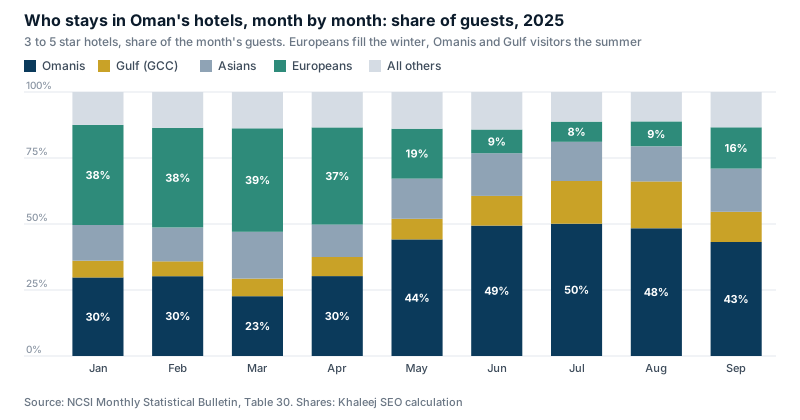
The more useful finding is who fills the rooms. Europeans were 37.9% of guests in January 2025 and 7.7% in July: 86,980 guests against 12,989, a 6.7-fold swing. Omanis went the other way, from 29.8% of guests in January to 50.1% in July. Guests from the GCC peaked in August at 36,482, or 17.7%. Summer demand is domestic and Gulf; winter demand is European. Across all hotel classes, Omanis were 2.15 million of the 5.13 million guests of 2025 (42%), which is why hotel guests outnumber inbound visitors.
2026 so far: visitors held, hotels did not
| Indicator | Earlier period | 2026 | Change |
|---|---|---|---|
| Inbound visitors, January to June | 1.80 million | 1.80 million | 0.0% |
| Inbound visitors in June | 266,969 | 223,253 | -16.4% |
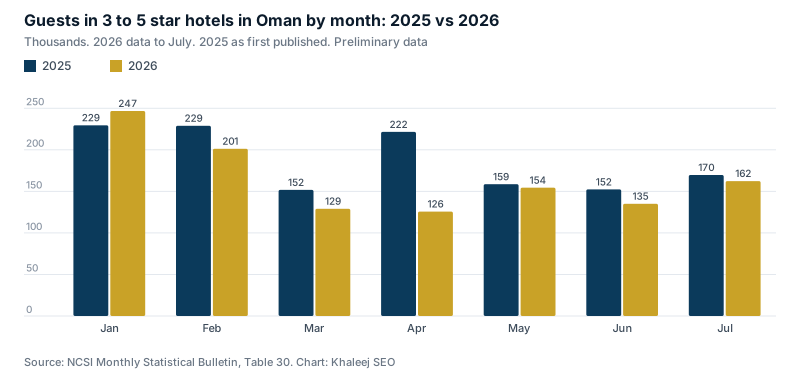
| Guests in 3 to 5 star hotels, January to June | 1,140,086 | 992,009 | -13.0% |
| Hotel revenue, January to June (OMR million) | 141.5 | 124.2 | -12.2% |
| Hotel occupancy, January to June | 54.6% | 46.3% | -8.3 points |
| Guests in 3 to 5 star hotels, January to July | 1,309,792 | 1,154,436 | -11.9% |
| European guests, January to July | 370,590 | 257,921 | -30.4% |
| Omani guests, January to July | 468,854 | 482,031 | +2.8% |
The pattern is a calendar that bends in one place. Omani guests rose and Asian guests were flat (+1.3%), while GCC guests fell 19.1% and Europeans fell 30.4%. April was the sharpest month: 14,193 European guests against 81,549 in April 2025, a fall of 82.6%. Visitors from India rose 25.5% in the first half, to 382,015. No NCSI or ministry document we read gives a cause for the hotel decline, and we do not suggest one. The comparison matters because Europeans are the winter segment.
Hotels: two measures, two occupancy rates
NCSI counted 1,475 hotel establishments in 2025 with 39,687 rooms and 5.13 million guests, who generated OMR 359.0 million of revenue at 38.6% occupancy. The 3 to 5 star hotels among them hosted 2.38 million guests, earned OMR 297.3 million (82.8% of the total) and ran at 56.7% occupancy, up from 49.9% in 2024. Both numbers are correct. They describe different hotels, so a hotel benchmarking itself needs to choose the right one.
One figure needs care. The number of hotels jumped from 1,031 in 2024 to 1,475 in 2025 (+43%), while rooms rose only 10.4% (35,948 to 39,687). The bulletin gives no explanation, so do not read it as 444 new hotels.
Spending: more visitors’ money, more residents’ money abroad
Inbound spending was OMR 1,013.5 million in 2025. Outbound spending, by Oman residents travelling abroad, was OMR 1,843.2 million, so the tourism balance was minus OMR 829.7 million, wider every year since 2021: minus 207.4 million (2021), 258.3 million (2022), 549.9 million (2023), 767.0 million (2024). For every riyal visitors spent in Oman, residents spent 1.82 riyals abroad (Khaleej SEO calculation). Per trip the gap is small, OMR 218.6 for an outbound visitor against OMR 255.5 for an inbound one, so the difference comes from the 8.4 million outbound visitors, against 3.97 million inbound.
Dhofar: a European winter and a Khareef summer
Dhofar, the governorate of Salalah, has two seasons that look nothing alike. In its hotels, Europeans spent 350 thousand of 728 thousand nights in 2025 (48.1%), against Omanis’ 188 thousand (25.8%), and the European share was 49.8% in 2024 and 46.4% in 2023. The Khareef, the monsoon summer, is mostly a road-trip season: the Ministry’s sheet counts 962,196 visitors to Salalah during the 2023 season, 25.5% above 2019, and 75.1% of them crossed a land border (722,795). The Ministry’s Khareef sheet stops at 2023 and counts arrivals, not hotel stays, so the two numbers describe different things.
Oman against its tourism targets
NCSI’s tourism satellite account puts tourism’s direct share of GDP at 2.7% in 2025, unchanged from 2024 and up from 2.5% in 2023, with a direct value added of OMR 1.11 billion. In March 2025 the Minister of Heritage and Tourism told the Majlis Ash’shura that indicators showed the sector reaching 3.5% of GDP by 2030 (reported by the Oman Observer; it is a ministerial statement, not a published target document). At 2.7%, Oman is 77% of the way to that figure (Khaleej SEO calculation).
Where the official sources disagree
- 2022 visitors have two totals. NCSI’s bulletins give 2,982 thousand and the Ministry of Heritage and Tourism’s sheet gives 2,920 thousand. The two agree for 2023 (3,992 thousand). We use NCSI for 2022, and the Ministry only for 2019.
- Tourism’s share of GDP depends on the series. For 2022, NCSI’s tourism satellite account says 2.0% and the Ministry’s sheet says 2.4%. We use NCSI.
- Hotel occupancy has two values for the same year: 38.6% for all establishments and 56.7% for 3 to 5 star hotels.
- Monthly numbers are revised. Guests in the first half of 2025 were 1,142,702 in the issue of July 2025 and 1,140,086 in the 2026 comparison. We quote year-on-year changes from the newest issue, and the chart uses 2025 months as first published.
- Watch the decimal point. Hotel revenue for January to June 2026 is OMR 124.2 million (OMR 124.177 million in the NCSI release); at least one headline printed it as 1.242 million.
What this means for hotels, tour operators and travel companies
- Run two calendars. English pages for the European winter need to be live and indexed weeks before November, and Arabic pages for Omani and Gulf guests before May and the Khareef. Our travel and hotel SEO work builds a permanent page for each season that is updated at the same address every year. If you sell to European travellers, our guide on how Oman tour operators win bookings from Europe shows which language pages to build first.
- Do not treat the GCC as one audience. It now sends almost as many same-day visitors (756 thousand) as overnight tourists (766 thousand). Short-break pages and route-based searches suit those trips, and they are written in Gulf Arabic rather than translated. Our Arabic keyword research guide explains how to find the wording.
- Know which segment you are exposed to. A hotel that depends on European winter guests has felt the 2026 fall most; one that sells to Omani guests in summer has not. Searches in Arabic for domestic trips and in English for long stays are different projects.
- Benchmark against the right occupancy. A resort or city hotel in the 3 to 5 star group compares itself with 56.7%, not 38.6%.
- Plan against the whole market. Compare each month with the same month a year earlier, and read the neighbours: our Qatar tourism statistics and Saudi Arabia tourism statistics show the same winter and summer logic at different scales, and our Bahrain tourism statistics show a market with no single season at all. Our SEO agency in Oman page explains how we plan this for Muscat and Salalah businesses.
Want to know whether your site is ready for its season? Ask for a free SEO audit and we will send the issues holding it back within 48 hours.
Methodology and sources
- NCSI, Tourism Statistics Bulletin 2026 (PDF): annual visitors, spending, hotels and the tourism satellite account for 2021 to 2025 (tables 1 and 2, pages 62 to 66), hotel guests and nights by nationality and governorate (tables 6 and 7, pages 99 to 102). 2025 data are preliminary and 2024 provisional.
- NCSI, Tourism Indicators Report, December 2025 issue (PDF): the 2025 visitor total, the top nationalities and the 3 to 5 star hotel summary. July 2026 issue (PDF): visitors and hotels to June 2026.
- NCSI, Monthly Statistical Bulletin, table 30: guests, revenue and occupancy of 3 to 5 star hotels by month and nationality group (issues of April, July and October 2025, June 2026 and August 2026). The 2025 monthly values are as first published.
- Ministry of Heritage and Tourism, statistics sheets (statistics page): general indicators 2005 to 2023 (the 2019 base) and Khareef visitors to Salalah by port of entry and nationality, 2009 to 2023. The sheets cite NCSI as the source.
- Oman Observer (24 March 2025 and 3 August 2026): the 2030 ministerial statement and an independent check of the January to June 2026 hotel figures, which match NCSI.
- Our calculations (shares, growth rates, seasonal averages, the guest mix, spending ratio and progress to 3.5%) use the values in the CSV. Occupancy averages are simple means of monthly rates. Not used: a complete monthly series of visitor arrivals (NCSI publishes only the latest month against a year earlier), Khareef counts for 2024 and 2025 (no official sheet found) and cruise passengers after March 2024.
Free download: oman-tourism-statistics.csv, with 324 rows: the headline figures, annual series, nationality groups, hotel figures and every monthly hotel value we obtained, each with its source and page.
How to cite this page
Khaleej SEO, “Oman tourism statistics: 2025 visitors, hotels and two seasons”, khaleejseo.com/blog/oman-tourism-statistics/, updated 19 October 2026. The charts may be reused with this credit and a link.
Updates
- 19 October 2026: first published, with 2026 data to June (visitors) and July (hotels). We update the page when NCSI releases a new monthly report or the next annual bulletin.
Arabic and English SEO specialists for e-commerce stores, dental clinics and travel companies. Our team has led SEO for some of the largest e-commerce brands in the Gulf, across 7 MENA markets.