Saudi internet statistics: 99% are online, and a person is not a page view
How many people use the internet in Saudi Arabia, on which devices, for how long, with which browser and search engine, at what speed. Figures from CST, GASTAT, DataReportal and StatCounter side by side, where they disagree, and a free CSV that names the source of every number.
 The Khaleej SEO team
Published · Updated · 10 min read
Key finding: About 99 in 100 people in Saudi Arabia use the internet: 99.6% in the Communications, Space and Technology Commission (CST) report, 99.0% in the General Authority for Statistics (GASTAT) survey, and 34.4 million users in DataReportal’s count. Almost all of them use a phone, yet phones carried between 59.7% and 80.0% of Saudi page views in the 13 months to September 2026. A person who uses a phone is not a page view on a phone, and the gap changes how you plan.
The numbers below put four sources side by side: CST’s Saudi Internet 2025 report (5th edition, released 19 July 2026), GASTAT’s 2025 survey of households and individuals, DataReportal’s Digital 2026 report for Saudi Arabia (8 November 2025) and StatCounter’s monthly Saudi series, downloaded on 21 October 2026. Where they disagree, we say so and say why. There is a free CSV at the end with the source of every figure.
Saudi internet at a glance
| Figure | Value | Source and period |
|---|---|---|
| People who use the internet | 99.6% (CST), 99.0% of ages 15 to 74 (GASTAT) | 2025 |
| Internet users | 34.4 million, 99.0% of the population (capped at 99%) | DataReportal, October 2025 |
| Online 7 hours or more a day | 61.3% of internet users | CST, 2025 |
| Online at least once a day | 96.8% of individuals aged 15 to 74 | GASTAT, 2025 |
| Use a phone to go online | 98.4% of individuals (GASTAT), 99.6% of users (CST) | 2025 |
| Share of page views on phones | 73.4% over 12 months; 59.7% to 80.0% by month | StatCounter, September 2025 to September 2026 |
| Median mobile download speed | 216 Mbps, 320 Mbps on 5G | CST (Ookla data), 2025 |
| Median fixed download speed | 151 Mbps | CST (Ookla data), 2025 |
| Mobile data used per person | 53 GB a month | CST, 2025 |
| Google’s share of search referrals | 95.7% (Bing 2.6%) | StatCounter, 12 months to September 2026 |
| Chrome and Safari | 72.4% and 21.2% of page views (StatCounter); 72.9% and 20.9% (CST) | 2025 and 2026 |
| Saudi domain names | 84,000, up 18% | CST, 2025 |
| People who shop online | 76.9% of internet users (CST), 71.0% of individuals 15 to 74 (GASTAT) | 2025 |
How many people use the internet in Saudi Arabia?
All three sources say about 99%, and they count differently.
| Source | Figure | Who is counted | Note |
|---|---|---|---|
| CST, Saudi Internet 2025 | 99.6% (men 99.8%, women 99.4%) | Age breakdown covers 10 to 74; the base is not stated | No sample size, survey dates or method published in the report |
| GASTAT, ICT access and usage 2025 | 99.0% (men 99.0%, women 98.9%; Saudis 99.3%, non-Saudis 98.6%) | Individuals aged 15 to 74 | Household survey |
| DataReportal, Digital 2026 | 34.4 million users, 99.0% | Total population of 34.7 million, all ages | Kepios analysis of ITU, GSMA Intelligence, regulator and advertising-tool data; capped at 99% |
The one age band that falls below 99.8% in CST’s table is 60 to 74, at 92.8%. DataReportal adds the connection side: 48.7 million cellular mobile connections at the end of 2025, equal to 140% of the population because one person can hold several, and 98.5% of those connections on 3G, 4G or 5G networks. It also counts 38.6 million social media user identities, 111% of the population, which it warns may not be unique people. Our Saudi social media statistics page shows that this total equals TikTok’s advertising reach.
For a business, the practical reading is that “are Saudis online” is settled. The useful questions are which device, when, and how a source measured it.
Phone, computer or tablet: people versus page views
This is where the sources look like they contradict each other and do not.
| Device | CST: internet usage by device type | GASTAT: individuals aged 15 to 74 who use it to go online | StatCounter: share of page views |
|---|---|---|---|
| Phone (mobile) | 99.6% | 98.4% | 73.4% |
| Computer or laptop | 47.4% (computers) | 8.6% (laptop) | 25.9% (desktop) |
| Tablet | 39.2% | 9.9% | 0.7% |
| Other devices | 30.7% (smart watches, gaming platforms, e-book readers) | 1.3% (other mobile devices) | not reported |
| Total | 216.9% | 118.2% | 100% |
CST does not state the base of its device table; we read it as internet users. The two surveys ask people which devices they use, so each person can appear several times and the shares add to more than 100%: 216.9% in CST’s table and 118.2% in GASTAT’s. StatCounter counts page views, and each page view happens on one device, so the shares add to 100%. Nearly everyone uses a phone and a quarter of page views still happen on a computer. Both statements are true at once.
The two surveys also disagree with each other on computers (47.4% against 8.6% for laptops) and tablets (39.2% against 9.9%). Neither document explains the gap on the pages we read, so we treat device ownership figures as a range and use a site’s own analytics for decisions.
StatCounter’s source is page views to the websites that install its tracking code (more than 1 million sites worldwide, according to its FAQ), so its Saudi series reflects that sample, not every Saudi website. The monthly series moves a lot.
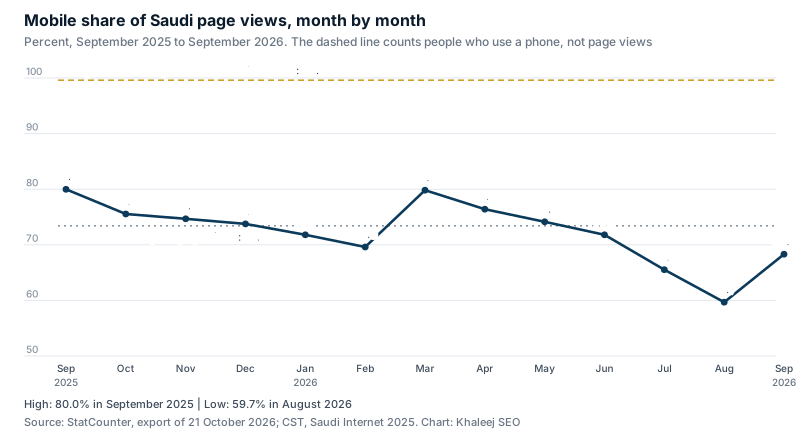
The mobile share was 80.0% in September 2025, 79.8% in March 2026, 59.7% in August 2026 and 68.3% in September 2026: a 20.3 point swing in 12 months. StatCounter states no cause on the pages we read, so we do not offer one. The lesson is simpler: a single month’s “mobile share” is a weak basis for a plan.
CST gives a third way to count: by data volume, mobile and fixed internet each carry 50% of Saudi traffic, and the average person uses 53 GB of mobile data a month, which CST puts at three times the global average.
When and how long Saudis are online
CST reports that 61.3% of internet users are online 7 hours or more a day (59.4% of men and 63.8% of women), 34.1% for 3 to 6 hours and 4.6% for under 3 hours. Peak hours are 9 pm to 11 pm, the peak day is Friday and the peak month is March; in 2025, Ramadan fell in March. By location, 84% access the internet on the go, 77.5% at home and 41.4% at work.
GASTAT measures frequency instead: 96.8% of individuals aged 15 to 74 use the internet at least once a day, 2.4% weekly and 0.8% monthly. It reports 98.7% using the internet at home and 48.7% while travelling, which differs from CST’s 77.5% and 84% because the two surveys ask different questions.
Browsers, operating systems and search engines
| Browser | CST | StatCounter, 12 months | StatCounter, monthly range |
|---|---|---|---|
| Chrome | 72.9% | 72.4% | 54.6% to 79.8% |
| Safari | 20.9% | 21.2% | 14.9% to 35.9% |
| Microsoft Edge | 2.0% | 2.1% | |
| Samsung Internet | 1.5% | 1.5% | |
| Firefox | 0.4% | 0.6% |
The 12-month StatCounter figures match CST’s browser shares within 0.5 point. The monthly series do not stay put: Chrome fell from 79.8% in May 2026 to 54.6% in September 2026 while Safari rose from 14.9% to 35.9%.
Mobile operating systems show the same instability. CST reports 60% Android and 40% iOS for mobile phones. StatCounter’s 12-month aggregate is 71.0% Android and 28.9% iOS, and its monthly iOS share runs from 20.8% (May 2026) to 52.3% (August 2026). On computers, CST reports Windows 81%, Mac 17% and Linux 1.2%.
| Search engine | All devices | Desktop | Mobile |
|---|---|---|---|
| 95.7% | 91.8% | 97.9% | |
| Bing | 2.6% | 6.4% | 0.4% |
| Yandex | 1.2% | 1.0% | 1.3% |
| Yahoo | 0.3% | 0.7% | 0.05% |
| DuckDuckGo | 0.15% | 0.12% | 0.16% |
CST ranks the same five engines in the same order: Google, Bing, Yandex, Yahoo, DuckDuckGo. It publishes the ranking, not the shares. StatCounter’s shares are of search referrals to its sites.
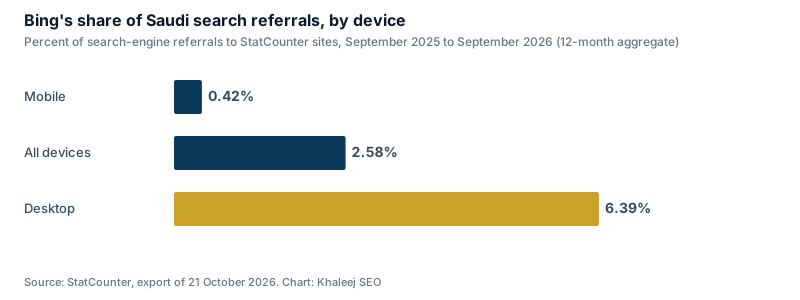
Bing’s share on desktop is 15.2 times its share on mobile (6.39% against 0.42%), and in the monthly desktop series it never falls below 5.7% and reaches 9.5% in September 2026. Bing is a small engine overall and a visible one on computers.
What Saudis search for and which sites they visit
CST publishes two lists without volumes. The keywords it says were most searched on Google in the Kingdom:
| Rank | Keyword | Meaning |
|---|---|---|
| 1 | مترجم | translator |
| 2 | ابشر | Absher, the government services platform |
| 3 | نور | Noor |
| 4 | ترجمة | translation |
| 5 | يوتيوب | YouTube |
| 6 | قوقل | |
| 7 | مدرستي | Madrasati, the schools platform |
| 8 | الهلال | Al Hilal |
| 9 | weather | weather |
| 10 | translate | translate |
Every one of the ten is a name, a service or a tool. None is a product, a price or a “best” query. The most visited websites in CST’s list are wikipedia.org, youtube.com, instagram.com, x.com, moe.gov.sa, whatsapp.com, absher.sa, chatgpt.com, kooora.com and nahdionline.com. Among sites on the .sa domain the list runs moe.gov.sa, absher.sa, haraj.com.sa, qiwa.sa, hrsd.gov.sa, amazon.sa, najiz.sa, etec.gov.sa, my.gov.sa and binbaz.org.sa. CST’s report also covers AI tool use; we cover that in AI adoption in Saudi Arabia.
Speed and data
| Measure | CST 2024 | CST 2025 | DataReportal (Ookla), end of 2025 |
|---|---|---|---|
| Median mobile download | 203 Mbps | 216 Mbps | 194.49 Mbps |
| Median 5G download | 320 Mbps | ||
| Median mobile upload | 18 Mbps | ||
| Median mobile latency | 24 ms | ||
| Median fixed download | 120.4 Mbps | 151 Mbps | 126.35 Mbps |
| Median fixed upload | 73 Mbps | ||
| Median fixed latency | 8 ms |
CST’s mobile median rose 6.4% in 2025 and its fixed median 25.4%, and CST says the mobile speed ranks among the top five in the G20. Its footnote says the figures come from Ookla’s Speedtest Intelligence data with the calculation adjusted to Ookla’s 2025 method. DataReportal’s Ookla figures are lower because they cover a different period; its text gives the change as 72.21 Mbps (59.1%) in the 12 months to August 2025.
On volume, CST counts 69 million terabytes of traffic, 56% of it local and 44% international.
Saudi domain names
| Measure | Value |
|---|---|
| Saudi domain names, 2023 | 57,700 |
| Saudi domain names, 2024 | 71,000 (+23.1%) |
| Saudi domain names, 2025 | 84,000 (+18.3%) |
| Newly registered domains, shown with the 2025 total | 26,000 |
| By extension | .sa 59%, .com.sa 31%, .org.sa 5%, other 4%, .gov.sa 1% |
| By registrant | private sector 96%, government 2%, individuals 2% |
| By time since registration | 1 to 2 years 62%, 3 to 5 years 16%, more than 5 years 22% |
Two things stand out. First, 62% of all Saudi domains were registered in the last one to two years. Second, CST reports 26,000 newly registered domains next to the 2025 total, which rose by 13,000. If the 26,000 are 2025 registrations, about 13,000 domains must have lapsed or been removed in the year. CST does not say so, which makes that arithmetic, not a stated figure.
Google’s documentation on multi-regional sites says a country-code top-level domain is a strong signal to users and search engines that a site is intended for one country, and lists its limits: it can target a single country only and some ccTLDs have eligibility rules. For a Saudi business, that makes the .sa and .com.sa choice a targeting decision, not a cosmetic one.
Online shopping
| Measure | CST | GASTAT |
|---|---|---|
| People who buy online | 76.9% of internet users (men 70.2%, women 85.6%) | 71.0% of individuals 15 to 74 (Saudis 80.2%: women 82.8%, men 77.6%) |
| Bought clothing and footwear | 87.7% of online shoppers | 88.8% |
| Bought cosmetics | 46.2% | 40.2% |
| Shopped on local websites | 95.3% | not reported |
| Shopped on international websites | 55.4% | not reported |
CST’s two website figures add to more than 100% and the report does not state their base, so we read them as the share of online shoppers who use each kind of site, with many using both. Both surveys agree on the direction: women shop online more than men, and clothing leads. CST adds that 41.8% buy groceries, 36.9% computers and smartphones and 36.5% travel services. For the spending side see Saudi e-commerce statistics and Saudi digital payments statistics.
Where the sources disagree
| Question | What the sources say | How to read it |
|---|---|---|
| How many are online? | 99.6% (CST), 99.0% (GASTAT), 99.0% (DataReportal, capped) | Different populations; use “about 99%” |
| How many use a computer? | 47.4% (CST) against 8.6% laptop (GASTAT) | Different questions; check your own analytics |
| Where do people go online? | At home 77.5% (CST) against 98.7% (GASTAT) | Different questions |
| Android or iOS? | 60 / 40 (CST) against 71.0 / 28.9 (StatCounter, 12 months) | Devices against page views; monthly values swing |
| Mobile share? | 99.6% of users, 73.4% of page views, 50% of data volume | Three different things |
| Mobile speed? | 216 Mbps (CST) against 194.49 Mbps (DataReportal) | Different periods and method |
| Online shoppers? | 76.9% (CST) against 71.0% (GASTAT) | Different bases |
What this means for SEO in Saudi Arabia
This section is our analysis, not a source figure.
- Build and test the mobile page first, then the desktop page. Google indexes and ranks the mobile version of a page, crawled with its smartphone agent (Google Search Central, updated 10 December 2025). A quarter of Saudi page views are still on desktop, so a site that is only checked on a phone loses those. Our technical SEO audits check both.
- Use your own device split, not a single month of anyone’s. StatCounter’s mobile share moved 20.3 points in a year. Read the device split from GA4 and Search Console for your own audience, and plan with the 12-month range.
- Register with Bing, especially for B2B. Bing is 6.4% of desktop referrals in Saudi Arabia against 0.4% of mobile. Sites whose buyers research at a desk, such as B2B services, software and professional firms, are the ones most likely to see it. Bing Webmaster Tools is free.
- Test checkout and forms in Safari on iPhone. iOS is 28.9% of mobile page views (StatCounter, 12 months) and 40% of phones (CST), and Safari was about 21% of all page views in both sources. A layout that only works in Chrome breaks for roughly a fifth of page views.
- Treat speed as a page problem. With a median mobile download of 216 Mbps, the network is unlikely to be the main limit for most visitors. Google’s Core Web Vitals thresholds (LCP within 2.5 seconds, INP under 200 milliseconds, CLS under 0.1) measure the page’s own loading, responsiveness and stability, which a fast network does not fix.
- Plan content around navigational demand. The ten most searched keywords in CST’s list are names, services and tools. Separate branded and non-branded queries in Search Console, and keep Arabic and English forms of the same term. Our guide to Arabic keyword research and our Arabic SEO service cover how.
- Match local intent for stores. In CST’s figures local websites reach 95.3% against 55.4% for international ones, and women shop online more than men, so e-commerce SEO pages should speak to local delivery, returns and payment methods first.
Starting a Saudi SEO programme? See our SEO agency in Saudi Arabia page, or ask for a free SEO audit.
Methodology and sources
- CST, Saudi Internet 2025 (5th edition), report page and PDF, news release of 19 July 2026. Pages used: 3 to 5 (penetration), 8 to 10 (time, devices, packages), 13 to 14 (online shopping), 16 to 17 (websites, browsers, search), 44 to 46 (speed and traffic), 50 to 53 (domain names). The report names three sources (CST data, SensorTower and Ookla) and gives no sample size, survey dates or method for its user figures. We read each figure on the rendered page.
- GASTAT, ICT access and usage by households and individuals 2025, survey of individuals aged 15 to 74.
- DataReportal, Digital 2026: Saudi Arabia, published 8 November 2025, with data from October 2025.
- StatCounter Global Stats, Saudi Arabia, CSV exports downloaded on 21 October 2026 for September 2025 to September 2026 (device, search engine, browser and mobile operating system, all devices, desktop and mobile); the device series was downloaded twice and was identical. StatCounter measures page views to sites that use its tracking code, see its FAQ, and we did not check the size of its Saudi sample.
- Google Search Central, mobile-first indexing best practices, Core Web Vitals and managing multi-regional and multilingual sites, all updated 10 December 2025.
- Our calculations (sums of device shares, ranges, growth rates, the Bing ratio and the domain arithmetic) use the values in the CSV. Not used: any source that gave no method or date.
Free download: saudi-internet-statistics.csv, with 321 rows: CST, GASTAT and DataReportal figures with their page references, StatCounter monthly series and 12-month aggregates, and our calculations, each with its source.
How to cite this page
Khaleej SEO, “Saudi internet statistics: 99% are online, and a person is not a page view”, khaleejseo.com/blog/saudi-internet-statistics/, updated 21 October 2026. The charts may be reused with this credit and a link.
Updates
- 21 October 2026: first published, with CST and GASTAT 2025 data, DataReportal October 2025 data and StatCounter data to September 2026. We update the page when DataReportal publishes its next Saudi report, when StatCounter adds a month, and when CST or GASTAT release new editions.
Arabic and English SEO specialists for e-commerce stores, dental clinics and travel companies. Our team has led SEO for some of the largest e-commerce brands in the Gulf, across 7 MENA markets.