AI adoption in Saudi Arabia: 2026 statistics
How many people and businesses in Saudi Arabia use AI? The official CST and GASTAT figures by age, gender, region and purpose, Microsoft's Gulf comparison, why the numbers disagree, and a free CSV of every figure.
 The Khaleej SEO team
Published · Updated · 9 min read
Key figures: 45.2% of internet users in Saudi Arabia use AI tools, up from 21.5% in the previous edition of the same official report, according to the Communications, Space and Technology Commission (CST). Women lead men (52.8% against 39.4%), people aged 20 to 29 lead every age group (55.7%), and 80.8% of AI users use it to search for information. On the business side, 33.1% of Saudi establishments that use the internet used AI technologies in 2025, up from 27.6% in 2024 (GASTAT).
This page collects the official statistics on AI adoption in Saudi Arabia in one place, each with its source and date, adds our own comparison of the 2024 and 2025 CST reports, and explains why the main AI adoption numbers for the Kingdom disagree. Compiled by the Khaleej SEO research team; every source below was opened on 14 October 2026. For the same CST report’s figures on devices, browsers, search engines and speed, see our Saudi internet statistics.
AI in Saudi Arabia at a glance
| Figure | Value | Source and period |
|---|---|---|
| Internet users who use AI tools | 45.2% | CST, Saudi Internet 2025 (published 19 July 2026) |
| Same measure, previous report | 21.5% | CST, Saudi Internet 2024 |
| Women who use AI tools | 52.8% | CST, Saudi Internet 2025 |
| Men who use AI tools | 39.4% | CST, Saudi Internet 2025 |
| Highest age group (20 to 29) | 55.7% | CST, Saudi Internet 2025 |
| AI users who use it for information search | 80.8% | CST, Saudi Internet 2025 |
| Internet-using establishments using AI technologies | 33.1% (2025), 27.6% (2024) | GASTAT, Establishments ICT Access and Usage Statistics |
| Generative AI users among people aged 15 to 64 | 31.4% (Q2 2026), rank 25 | Microsoft AI Economy Institute, company estimate |
How many people in Saudi Arabia use AI?
45.2% of internet users in the Kingdom use AI tools, according to CST’s Saudi Internet 2025 report, which CST released on 19 July 2026. CST describes this as the adoption rate of AI tools among internet users, “more than double” the previous year. The Saudi Internet 2024 report, published in May 2025, gave 21.5% for the same indicator. By our calculation, that is 2.1 times the earlier figure.
Internet penetration in the same report is 99.6%. The AI figure is a survey measure of internet users, not a count of accounts or app downloads.
Who uses AI in Saudi Arabia: age and gender
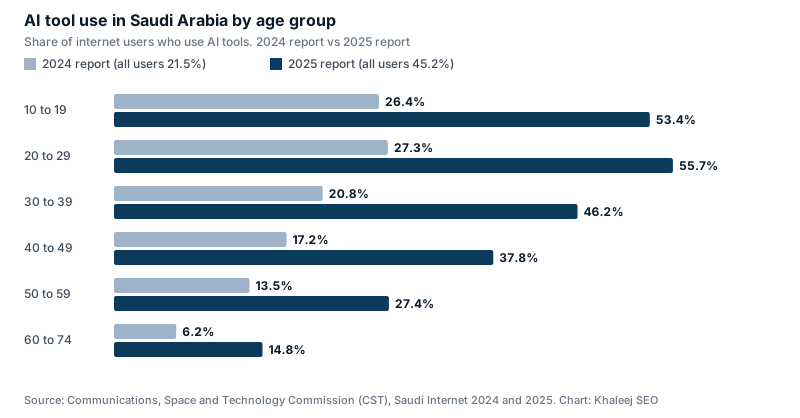
| Age group | 2024 report | 2025 report | Change (Khaleej SEO calculation) |
|---|---|---|---|
| 10 to 19 | 26.4% | 53.4% | x2.0 |
| 20 to 29 | 27.3% | 55.7% | x2.0 |
| 30 to 39 | 20.8% | 46.2% | x2.2 |
| 40 to 49 | 17.2% | 37.8% | x2.2 |
| 50 to 59 | 13.5% | 27.4% | x2.0 |
| 60 to 74 | 6.2% | 14.8% | x2.4 |
What the two reports show side by side:
- Every age group at least doubled. The oldest group grew fastest in relative terms (6.2% to 14.8%), while people in their 20s added the most points (27.3% to 55.7%).
- Women use AI more than men, and the gap widened. 52.8% of women against 39.4% of men in the 2025 report; 27.7% against 17% in the 2024 report. The gap grew from 10.7 to 13.4 percentage points.
- Women use AI more for study, men more for work. Among AI users, 42.4% of women use it for study and education against 32.9% of men, and 20% of men use it for work-related tasks against 14.6% of women.
AI use by region
The 2025 report also breaks AI tool use down by region. Tabuk has the highest rate and Jazan the lowest.
| Region | Internet users who use AI tools (2025 report) |
|---|---|
| Tabuk | 58.5% |
| Eastern Province | 53.8% |
| Al Madinah | 50.8% |
| Riyadh | 50.2% |
| Aseer | 48.9% |
| Al Qassim | 46.6% |
| Al Bahah | 46.6% |
| Makkah | 43.2% |
| Northern Borders | 42.0% |
| Hail | 39.7% |
| Al Jowf | 35.1% |
| Najran | 32.2% |
| Jazan | 30.7% |
What people in Saudi Arabia use AI for
| Purpose | All AI users | Men | Women |
|---|---|---|---|
| Information search | 80.8% | 80.8% | 80.7% |
| Idea generation | 40.1% | 40.3% | 40.0% |
| Study and education | 37.7% | 32.9% | 42.4% |
| Image, video or presentation creation | 25.7% | 21.6% | 29.7% |
| Language translation | 25.1% | 23.4% | 26.8% |
| Work-related tasks | 17.3% | 20.0% | 14.6% |
| Writing | 14.3% | 14.6% | 14.1% |
| Programming and technical tasks | 13.5% | 12.8% | 14.3% |
Source: CST, Saudi Internet 2025. The shares add up to more than 100% because people use AI for more than one purpose. CST does not state the base, but since 80.8% is higher than the 45.2% who use AI at all, these can only be shares of AI users.
The headline for anyone who sells online: four in five AI users in Saudi Arabia use it to look things up. AI assistants have become a second search box, next to Google, which CST lists as the most used search engine in the Kingdom.
The most downloaded AI apps in Saudi Arabia
CST ranks the most downloaded AI applications in the Kingdom in this order (the report gives the ranking, not download counts):
- ChatGPT
- Google Gemini
- DeepSeek
- Grok
- Microsoft Copilot
- Meta AI
- Perplexity
- Manus AI
- Google NotebookLM
- HUMAIN
How many Saudi businesses use AI?
33.1% of establishments in Saudi Arabia that use the internet used artificial intelligence technologies in 2025, up from 27.6% in 2024, a relative growth of 20.0% according to the General Authority for Statistics (GASTAT). The base is establishments using the internet, which is 98.1% of all establishments. The survey covers a sample of 47,804 establishments, and GASTAT states that its methodology is aligned with UNCTAD standards for business ICT statistics.
| Economic activity | Establishments using AI (2025) |
|---|---|
| Information and communication | 61.1% |
| Financial and insurance | 52.9% |
| Education | 51.0% |
| Transportation and storage | 44.4% |
| Professional activities | 43.9% |
| Human health and social work | 35.6% |
| Accommodation and food service | 33.5% |
| Wholesale and retail trade | 30.2% |
| All establishments | 33.1% |
In 2024 the same three sectors led, at lower rates: information and communication 52.8%, finance and insurance 44.7% and education 42.1%. Retail sits below the national average, which matters for online stores: about seven in ten internet-using retail establishments do not use AI technologies yet.
Saudi Arabia against the Gulf: Microsoft’s estimate
Microsoft’s AI Economy Institute publishes a quarterly estimate of the share of people aged 15 to 64 who used a generative AI product, built from anonymised Microsoft telemetry and adjusted for device market share, internet penetration and population. It is a company estimate, not an official statistic, but it is the only regular source that compares Gulf countries on the same basis.
| Country | Q1 2026 | Q2 2026 |
|---|---|---|
| United Arab Emirates | 70.1% | 73.3% |
| Qatar | 41.8% | 43.5% |
| Saudi Arabia | 29.4% | 31.4% |
| Oman | 26.5% | 27.6% |
| Kuwait | 21.1% | 22.6% |
Saudi Arabia climbed from 30th to 25th place worldwide in the second quarter of 2026, which Microsoft calls the largest rise in rank in the report. Bahrain is not listed in the report’s country tables.
Surveys and company reports
These private surveys are useful context, but each covers a narrower group than the official figures above, so we keep them separate.
| Survey | What it found for Saudi Arabia | Who was asked, and when |
|---|---|---|
| Deloitte, Digital Consumer Trends 2026 (KSA edition) | 66% of consumers currently use generative AI, up from 49% a year earlier | 1,000 consumers aged 18 to 50, weighted, September 2025 |
| PwC, Middle East Workforce Hopes and Fears Survey 2025, Saudi findings | 69% of employees used AI in their job in the past 12 months (Middle East 70%, global 54%); 36% use generative AI weekly or daily | More than 400 respondents in Saudi Arabia |
| Tabby, shopping survey 2026 | 39.5% of shoppers in Saudi Arabia used AI for shopping decisions in the past 12 months (UAE 47.8%) | 20,999 respondents across Saudi Arabia and the UAE, November 2025 |
The Tabby figure is the closest to a buying signal: about two in five Saudi shoppers already let an AI tool help them choose what to buy.
Why the numbers disagree: 45.2%, 31.4% or 33.1%?
| Source | What it counts | Saudi figure |
|---|---|---|
| CST, Saudi Internet 2025 | Internet users who say they use AI tools (survey; the age breakdown runs from 10 to 74) | 45.2% |
| Microsoft AI diffusion | People aged 15 to 64 who used a generative AI product in the period (telemetry model) | 31.4% |
| GASTAT establishments survey | Internet-using establishments that use AI technologies | 33.1% |
| Deloitte Digital Consumer Trends | Consumers aged 18 to 50 who currently use generative AI (survey of 1,000) | 66% |
| PwC Hopes and Fears, Saudi findings | Employees who used AI in their job in the past 12 months | 69% |
| Tabby shopping survey | Shoppers who used AI for shopping decisions in the past 12 months | 39.5% |
All of them are real, and they answer different questions. CST asks people and includes teenagers, who are among the heaviest users. Microsoft infers use from its own telemetry and counts generative AI products only, then models the rest of the population. GASTAT counts businesses, not people. The private surveys sample narrower groups, such as adults up to 50, office workers or shoppers, so their figures run higher or lower than the national rate. So “almost half of Saudi internet users use AI” and “a third of Saudi businesses use AI” are both correct, and neither should be compared with the other as if it measured the same thing.
What this means for businesses in Saudi Arabia
- AI answers are part of search now. With 80.8% of AI users looking up information, being named in AI answers matters as much as ranking. Assistants tend to draw on pages that answer clearly, cite their sources and are easy to crawl, which is the same groundwork as good technical SEO.
- Arabic content decides who gets cited. Assistants can only cite Arabic pages that exist, and our Arabic internet statistics show how thin Arabic web content still is. Pages written in the words Saudi users type, built with Arabic SEO and real Arabic keyword research, are the ones an assistant can quote.
- Young and female audiences moved first. Brands that sell to women and to shoppers under 30, such as fashion, beauty and home stores, are the most likely to meet customers who already ask AI assistants before they buy. Our e-commerce SEO work covers both Google and AI answers, and our Saudi e-commerce statistics show how much of that spending already happens online.
- Regional differences are real. Riyadh (50.2%) and the Eastern Province (53.8%) are above the national rate, Jazan and Najran well below it. Businesses with branches across the Kingdom should not assume one behaviour everywhere; our SEO services in Saudi Arabia plan city by city.
Want to know whether AI assistants and Google can find and quote your site? Ask for a free SEO audit.
Methodology and sources
- CST, Saudi Internet 2025: report page https://www.cst.gov.sa/en/knowledge-center/reports/saudi-internet-25 and the English PDF (Artificial Intelligence section, pages 32 to 37), released 19 July 2026 (CST news release “Saudi Internet Report 2025 Highlights Digital Growth”). Opened 14 October 2026. The report gives the indicators as percentages and does not publish the sample size.
- CST, Saudi Internet 2024: Arabic PDF, page 15 (AI tool use 21.5%, men 17%, women 27.7%, age groups), published in May 2025. Opened 14 October 2026.
- GASTAT: Establishments ICT Access and Usage Statistics 2025 and 2024 bulletins (Figure 1 in each), from the ICT statistics page https://stats.gov.sa/en/w/eyys, and the methodology and quality report (sample of 47,804 establishments; AI indicator measured out of establishments using the internet). Opened 14 October 2026.
- Microsoft AI Economy Institute: Global AI Diffusion Q2 2026 Trends and Insights (September 2026), ranking on page 4 and the country table in the appendix. Opened 14 October 2026. Labelled as a company estimate throughout.
- Surveys and company reports: Deloitte Digital Consumer Trends 2026 KSA edition (pages 3 and 8), PwC Middle East Workforce Hopes and Fears Survey 2025 Saudi Arabia findings (page 5), Tabby shopping survey 2026 (page 22 and the methodology page). Opened 14 October 2026. Labelled as survey or company figures and never mixed with the official ones.
- Khaleej SEO calculations: growth multiples by age group, the change in the gender gap and the comparison table are our own arithmetic on the published figures. Figures are not mixed: each number carries the source that produced it.
Download every figure on this page as CSV: CST (2024 and 2025, by age, gender, region and purpose), GASTAT (2024 and 2025, by economic activity) and Microsoft (Q1 and Q2 2026, Gulf countries), with the source of each row.
How to cite this page
Cite the original source named next to each figure, for example “according to CST’s Saudi Internet 2025 report”. For the age group chart, the 2024 to 2025 comparison or the reconciliation table, please credit “Khaleej SEO analysis of CST data” and link to this page. The chart may be reused under CC BY 4.0 with a link to this page.
Updates
- 14 October 2026: first published, with CST Saudi Internet 2025, GASTAT establishments statistics 2025 and Microsoft AI diffusion Q2 2026. We update the page when CST, GASTAT or Microsoft publish a new edition.
Arabic and English SEO specialists for e-commerce stores, dental clinics and travel companies. Our team has led SEO for some of the largest e-commerce brands in the Gulf, across 7 MENA markets.