Arabic internet statistics 2026: users vs web content
How much of the web is in Arabic? The three main measures, from 0.6% to 3.65%, side by side with their definitions and dates, a Common Crawl series since 2018, and a free monthly tracker CSV of the Arabic share of web content.
 The Khaleej SEO team
Published · Updated · 8 min read
Key figures: Arabic speakers make up 4.36% of the world’s internet users (OBDILCI, July 2025), yet Arabic is the content language of only 0.6% of websites (W3Techs, 29 October 2026) and 0.67% of the pages in Common Crawl’s latest crawl. On the measures that count sites and pages, Arabic speakers are 6.5 to 7.3 times more present online than Arabic content. Arabic ranks 18th among website languages, behind Persian, and 19th among crawled page languages, where it moved just ahead of Persian in the latest crawl.
This page puts the main measures of Arabic on the internet side by side, with the definition and date of each, adds our own analysis of Common Crawl data from August 2018 to October 2026, and publishes a monthly tracker you can download. Compiled by the Khaleej SEO research team; W3Techs and Common Crawl were read again on 29 October 2026, and OBDILCI was opened on 4 October 2026.
Arabic on the internet at a glance
| Figure | Value | Source and date |
|---|---|---|
| Arabic speakers among internet users | 4.36% | OBDILCI model, version 6, July 2025 |
| Arabic speakers who are online | 67.75% | OBDILCI model, version 6, July 2025 |
| Arabic share of web content (modelled) | about 3.65%, plus or minus 20% | OBDILCI model, version 6, July 2025 |
| Arabic share of websites | 0.6% (rank 18) | W3Techs, 29 October 2026 |
| Arabic share of crawled web pages | 0.67% (rank 19) | Common Crawl, crawl CC-MAIN-2026-43 |
| Arabic pages in the latest crawl | 14.5 million | Common Crawl, crawl CC-MAIN-2026-43 |
| Arabic pages per crawled page | about 1 in 150 | Khaleej SEO calculation from Common Crawl, crawl CC-MAIN-2026-43 |
| English share of websites | 49.5% | W3Techs, 29 October 2026 |
| Persian share of websites | 1.0% (rank 14) | W3Techs, 29 October 2026 |
The most used languages on the internet
By websites, the top five content languages are English (49.5%), Spanish (6.1%), German (5.9%), Japanese (4.9%) and French (4.6%), according to W3Techs on 29 October 2026. Arabic, with 0.6%, sits 18th, behind Persian (1.0%), Turkish (1.6%) and Indonesian (1.2%). Ukrainian (0.6%) is listed just below it; on 4 October it was listed just above.
Common Crawl’s latest crawl (CC-MAIN-2026-43) gives a similar picture by pages: English 42.6%, Russian 6.3%, German 5.8%, Japanese 4.9%, French 4.8% and Spanish 4.7%, with Arabic 19th at 0.67% and Persian 20th at 0.62%.
OBDILCI’s model gives a very different order: English about 20.1% of content, Chinese 19.0%, Spanish 7.7%, then Hindi, Russian, Arabic, French and Portuguese at roughly 3% to 4% each. The gap between these rankings is the most misunderstood fact about Arabic online, so the next section explains it.
Why nobody agrees on how much of the web is Arabic
| Measure | What it counts | Arabic | Why it differs |
|---|---|---|---|
| W3Techs | One main content language per website, among the sites it surveys, where the language is known | 0.6% | A bilingual Arabic and English site usually counts once, often as English |
| Common Crawl | Pages in one crawl, by the primary language detected with CLD2 | 0.67% | Counts what the crawler fetched, so crawl choices and site sizes shape the result |
| OBDILCI | Modelled share of content, built from speakers, connectivity and many indicators | about 3.65% | Credits every language version of a multilingual site; carries a plus or minus 20% interval |
So when an article says “Arabic is only 1% of the internet” and another says “Arabic is a top-five web language”, both can cite a real source. The first counts sites or pages by main language; the second models all content. For a business, the practical point is the same either way: Arabic demand is far larger than the Arabic supply of good pages.
Arabic share of web pages since 2018
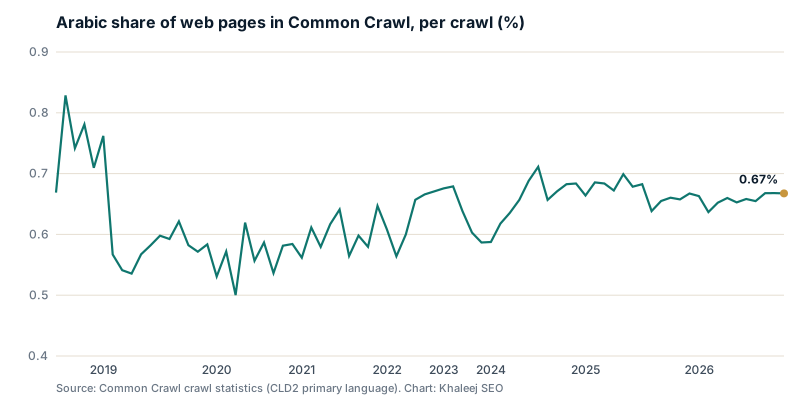
Across the 78 Common Crawl crawls from August 2018 to October 2026, the Arabic share of pages never left a narrow band: a high of 0.83% (September 2018) and a low of 0.50% (April 2020). The yearly average moved from 0.59% in 2019 to 0.67% in 2025. In other words, while Arabic speakers kept coming online, the Arabic share of the crawled web stood still.
W3Techs’ yearly series tells the same story by websites: 0.8% in January 2015, a peak of 1.2% in January 2022, then 0.5% in January 2025 and 0.6% today.
| 1 January | Arabic share of websites (W3Techs) |
|---|---|
| 2015 | 0.8% |
| 2018 | 0.7% |
| 2020 | 0.8% |
| 2022 | 1.2% |
| 2024 | 0.6% |
| 2025 | 0.5% |
| 2026 | 0.6% |
| 29 October 2026 | 0.6% |
Download the tracker as CSV: every Common Crawl crawl since August 2018 (Arabic share, Arabic rank, Persian share) and the W3Techs yearly and monthly values. The latest rows are Common Crawl crawl CC-MAIN-2026-43 and the W3Techs reading of 29 October 2026; W3Techs’ monthly series has read 0.6% for Arabic every month since December 2025. We add each new month.
Arabic is the steady one: Persian moved, not Arabic
In the latest crawl Arabic moved up from 20th to 19th among page languages. Its own share did not change: 0.67% in crawl CC-MAIN-2026-39 and 0.67% in CC-MAIN-2026-43. Persian’s did: it fell from 0.69% to 0.62% and dropped from 19th to 20th. In the table, each crawl is shown as year and week, so 2026-43 is crawl CC-MAIN-2026-43.
| Crawl (year-week) | Arabic share of pages | Persian share of pages | Arabic rank |
|---|---|---|---|
| 2026-04 | 0.66% | 0.19% | 19 |
| 2026-08 | 0.64% | 0.88% | 20 |
| 2026-12 | 0.65% | 0.20% | 19 |
| 2026-17 | 0.66% | 0.23% | 19 |
| 2026-21 | 0.65% | 0.29% | 19 |
| 2026-25 | 0.66% | 0.52% | 19 |
| 2026-30 | 0.65% | 0.70% | 20 |
| 2026-34 | 0.67% | 0.76% | 20 |
| 2026-39 | 0.67% | 0.69% | 20 |
| 2026-43 | 0.67% | 0.62% | 19 |
In every crawl of 2026, Arabic ranked 20th exactly when the Persian share was above its own (crawls 08, 30, 34 and 39) and 19th in the other six. Across the ten crawls the Arabic share stayed between 0.64% and 0.67%, while the Persian share moved between 0.19% and 0.88%. Since January 2024 (32 crawls) the Arabic share has stayed between 0.59% and 0.71%.
A rank swap between two neighbouring languages therefore says more about the other language than about Arabic. The data does not say why the Persian share swings from crawl to crawl, and we do not guess.
For a business, the steadier reading is the share itself: about 1 in every 150 crawled pages is Arabic (100 divided by 0.67, our calculation from CC-MAIN-2026-43).
What this means for businesses in the Gulf
- Less competition per Arabic query. With far fewer Arabic pages per Arabic searcher, a well researched Arabic page often faces weaker competition than its English twin. That is why we treat Arabic SEO as its own discipline, not a translation step.
- Translated pages waste the opportunity. A translated page uses dictionary Arabic, not the words Gulf customers type. Our Arabic keyword research guide shows how to find the real terms, including spelling variants.
- AI assistants read the same thin Arabic web. 45.2% of internet users in Saudi Arabia now use AI tools, and most use them to look things up (see our AI adoption statistics for Saudi Arabia). An assistant can only quote Arabic pages that exist, so the Arabic content gap carries over into AI answers.
- Bilingual sites are counted as English. If your Arabic version is thin or hidden behind a weak language switch, search engines and surveys alike see an English site. Clean hreflang and complete Arabic pages fix both, which is part of our technical SEO work.
- Online stores feel it most. Saudi shoppers spend online at scale (see our Saudi e-commerce statistics), yet many stores still publish category pages in English only. Our e-commerce SEO work starts with the Arabic categories.
Want to see how much Arabic demand your site is missing? Ask for a free SEO audit.
Methodology and sources
- W3Techs: “Usage statistics of content languages for websites” and its yearly and monthly historical trend reports, first opened 4 October 2026 and read again on 29 October 2026. W3Techs surveys widely visited websites and reports the share among sites whose content language it knows; reports are updated daily.
- Common Crawl: crawl statistics, “Distribution of Languages” (languages.csv), primary language by Compact Language Detector 2, percentage of pages per crawl. Latest crawl CC-MAIN-2026-43. Downloaded 4 October 2026 and again on 29 October 2026. Ranks exclude pages of unknown language. Yearly averages and ranks are our own calculations.
- OBDILCI: Observatory of Linguistic and Cultural Diversity on the Internet, indicators for the presence of languages, version 6 (July 2025) results table, opened 4 October 2026. The model uses Ethnologue and ITU data among many sources and states a plus or minus 20% confidence interval.
- Figures are not mixed: each number in this page carries the source that produced it.
How to cite this page
Cite the original source named next to each figure, for example “according to W3Techs”. For the comparison table, the chart or the tracker, please credit “Khaleej SEO analysis of Common Crawl and W3Techs data” and link to this page.
Updates
- 29 October 2026: added Common Crawl crawl CC-MAIN-2026-43 (Arabic 0.67%, up one rank to 19th as Persian fell from 0.69% to 0.62%), read W3Techs again (Arabic now listed 18th, still 0.6%), and added the 2026 Arabic and Persian table. The OBDILCI figures are unchanged (version 6, opened 4 October 2026).
- 4 October 2026: first published, with Common Crawl data to crawl CC-MAIN-2026-39 and W3Techs data to 4 October 2026. We update the tracker monthly.
Arabic and English SEO specialists for e-commerce stores, dental clinics and travel companies. Our team has led SEO for some of the largest e-commerce brands in the Gulf, across 7 MENA markets.