Ramadan shopping statistics: Gulf searches peak in the first days, and Saudi clothing spending peaks the week before Eid
Five seasons of Google Trends data for Saudi Arabia, the UAE, Kuwait, Qatar and Oman, read next to SAMA's weekly card spending by sector: when searches start, which words people type, where food, restaurants, clothing and jewelry peak, and what the 2027 calendar looks like.
 The Khaleej SEO team
Published · Updated · 10 min read
Key finding: In five Gulf markets, searches for Ramadan offers peak in the week that holds day one of Ramadan or the week after (23 of 24 country-seasons, 2022 to 2026), and in Saudi Arabia interest builds over about three weeks. Spending keeps other clocks: food peaks in the start week, and clothing’s share of card spending is 2.5 times its pre-Ramadan level the week before Eid.
This page reads Google Trends for Saudi Arabia, the United Arab Emirates, Kuwait, Qatar and Oman, then sets it beside SAMA’s weekly card spending by sector for Saudi Arabia. Trends gives an index, not a count of searches, and the card data counts payments at points of sale, so the method section says what each can and cannot show.
Ramadan shopping at a glance
| Figure | Value | Source and period |
|---|---|---|
| Peak week of searches for «عروض رمضان» (Ramadan offers) | The week that holds day one of Ramadan or the week after, in 23 of 24 country-seasons | Google Trends, 2022 to 2026 |
| Saudi searches 3, 2 and 1 weeks before the day-one week | 16%, 34% and 48% of the season’s peak (median) | Google Trends, 2022 to 2026 |
| Share of 12 weeks of Saudi interest in the day-one week and the next | 43% (median); 23% in the three weeks before | Our calculation from Google Trends |
| «عروض رمضان» (offers) against «تخفيضات رمضان» (discounts) | About 37 to 1 in Saudi Arabia, 33 to 1 in Kuwait, 14 to 1 in Qatar | Google Trends, five-year sums |
| Saudi food and beverages, share of card spending in the start week | Index 129 (120 to 133), where 100 is the weeks 8 to 5 before | SAMA weekly data, our analysis |
| Saudi clothing, share of card spending the week before the Eid week | Index 248 (191 to 273) | SAMA weekly data, our analysis |
| Saudi restaurants and cafes, lowest week | Index 62 to 70 | SAMA weekly data, our analysis |
| Ministry of Commerce “Ramadan discounts” season, 2026 | 1 February to 26 March, 54 days | Ministry of Commerce announcement |
The calendar we used
We call the Sunday to Saturday week that holds the first day of Ramadan the day-one week, and the week that holds Eid al-Fitr the Eid week. Weeks are counted from the day-one week: week 0 is that week, week -1 is the one before it, week +1 the one after. The dates are the ones timeanddate.com lists for Saudi Arabia; the 2027 dates are marked tentative there until the moon is sighted.
| Season | First day of Ramadan | Eid al-Fitr | Eid week is week |
|---|---|---|---|
| 2022 | Saturday 2 April | Monday 2 May | +5 |
| 2023 | Thursday 23 March | Friday 21 April | +4 |
| 2024 | Monday 11 March | Wednesday 10 April | +4 |
| 2025 | Saturday 1 March | Sunday 30 March | +5 |
| 2026 | Wednesday 18 February | Friday 20 March | +4 |
| 2027 (expected) | Monday 8 February | Wednesday 10 March | +4 |
The date moved 10 to 12 days earlier on the calendar in each step from 2022 to 2027. A shopping plan that copies last year’s weeks therefore starts late.
When Gulf shoppers search
For each country we compared five Arabic search terms on one scale: «عروض رمضان» (Ramadan offers), «تخفيضات رمضان» (Ramadan discounts), «زينة رمضان» (Ramadan decorations), «ملابس العيد» (Eid clothes) and «هدايا العيد» (Eid gifts). «عروض رمضان» is the largest term in every market, so it is the one we use for timing.
The peak week, by country and season (0 is the day-one week, +1 the week after):
| Country | 2022 | 2023 | 2024 | 2025 | 2026 |
|---|---|---|---|---|---|
| Saudi Arabia | +1 | +1 | 0 | +1 | 0 |
| United Arab Emirates | +1 | +1 | 0 | +1 | 0 |
| Kuwait | +2 | -1/0 | 0 | 0 | 0 |
| Qatar | +1 | +1/+2 | n/a | +1 | +1 |
| Oman | +1 | 0 | 0 | 0 | +1 |
Ties are listed with both weeks (-1/0 and +1/+2). Qatar in 2024 (n/a) reads 0 in every week on this scale, so it is left out, which leaves 24 country-seasons. In 23 of them the peak is in week 0 or week +1. In Saudi Arabia and the UAE the pattern follows the weekday: when Ramadan began on a Saturday or a Thursday (2022, 2023, 2025) the peak was in the following week, the first full one, and when it began on a Monday or a Wednesday (2024, 2026) it was in the day-one week.
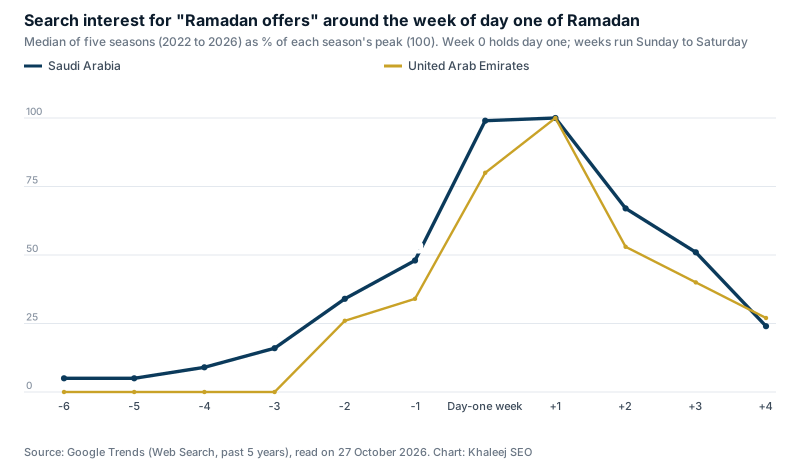
| Week | Saudi Arabia | United Arab Emirates |
|---|---|---|
| -5 | 5 | 0 |
| -4 | 9 | 0 |
| -3 | 16 | 0 |
| -2 | 34 | 26 |
| -1 | 48 | 34 |
| 0, the day-one week | 99 | 80 |
| +1 | 100 | 100 |
| +2 | 67 | 53 |
| +3 | 51 | 40 |
| +4 | 24 | 27 |
Each figure is the median of five seasons as a percentage of that season’s peak. The UAE zeros before week -2 are what Trends shows for low volumes, so the UAE ramp may start earlier than it looks. For Kuwait, Qatar and Oman the early weeks are mostly 0 for the same reason, which is why we state their peak week but not their ramp.
In Saudi Arabia, interest first reached 10% of the peak in week -3 in four of the five seasons (week -4 in 2026), 25% between week -3 and week -1, and 50% in week -1 or week 0.
What a page that ranks late misses
We took the 12 weeks from week -8 to week +3 and counted, for each Saudi season, the share already over when a given week starts.
| Your page starts to rank in week | Week starting in 2027 | Share of the 12 weeks already over |
|---|---|---|
| -4 | 10 January | 2% (2% to 4%) |
| -3 | 17 January | 5% (4% to 6%) |
| -2 | 24 January | 8% (8% to 11%) |
| -1 | 31 January | 15% (13% to 21%) |
| 0, the day-one week | 7 February | 26% (21% to 34%) |
| +1 | 14 February | 49% (38% to 57%) |
The figure is the median of five seasons with the range in brackets. By phase, a median 5% of the 12 weeks of Saudi interest fell in weeks -8 to -4, 23% in weeks -3 to -1, 43% in weeks 0 and +1, and 28% in weeks +2 and +3.
Which words people type
We summed each term’s weekly index over the five years of data (262 weeks). The sums show which words are used, not how many searches there were. The first table compares offers with discounts, the second shows the other three terms.
| Country | عروض رمضان (offers) | تخفيضات رمضان (discounts) | Offers to discounts |
|---|---|---|---|
| Saudi Arabia | 1,512 | 41 | 37 to 1 |
| United Arab Emirates | 1,305 | 11 | too few to rate |
| Kuwait | 956 | 29 | 33 to 1 |
| Qatar | 769 | 54 | 14 to 1 |
| Oman | 958 | 0 | not defined |
| Country | زينة رمضان (decorations) | ملابس العيد (Eid clothes) | هدايا العيد (Eid gifts) |
|---|---|---|---|
| Saudi Arabia | 494 | 208 | 474 |
| United Arab Emirates | 706 | 39 | 51 |
| Kuwait | 635 | 266 | 99 |
| Qatar | 396 | 57 | 0 |
| Oman | 539 | 620 | 111 |
In Saudi Arabia «عروض رمضان» takes 55% of the five terms, decorations 18%, Eid gifts 17%, Eid clothes 8% and discounts 2%. The offers wording is ahead of the discounts wording by the ratios in the first table. Oman shows 0 for discounts, and the UAE’s 11 points are too few to turn into a ratio. Eid clothes is large enough to read only in Kuwait and Oman: in Saudi Arabia its weekly peak never passed 18 on this scale.
The official name is not the searched name
The Saudi Ministry of Commerce runs the licensed «تخفيضات رمضان» season. Shops and online stores apply for a discount licence at sales.mc.gov.sa, and shoppers can scan the barcode on the licence to see the type, rate and duration of the discount. We read the ministry’s announcements for the two seasons below (54 days in 2026).
| Season | 2024 | 2026 |
|---|---|---|
| Opened | Tuesday 20 February | Sunday 1 February |
| Days before Ramadan | 20 | 17 |
| Week of the count | -3 | -2 |
| Saudi offers searches that week | 18% of the peak | 42% of the peak |
| Closed | 14 April, 4 days after Eid | 26 March, 6 days after Eid |
The ministry’s 2024 notice presented the season as a way to encourage early shopping and counted 3,331 licences covering more than 5 million products at that point. So the official window opens when searches are still ramping, and it runs past Eid. The word on the licence is «تخفيضات», the word shoppers type is «عروض»: a store page should carry both.
Decorations and Eid terms
Searches for «زينة رمضان» (decorations) peaked in week 0 in 22 of 25 readable country-seasons and in week -1 in the other three (Saudi Arabia and the UAE in 2024, Qatar in 2023). Where the peak was in week 0 in Saudi Arabia and the UAE (8 seasons), the next week was 16% to 33% of it. Decoration searches come before and at the start of the month, not during it.
The Eid terms sit at the other end. In Saudi Arabia «هدايا العيد» (Eid gifts) peaked in the week before the Eid week in three seasons and in the Eid week in two. In Oman «ملابس العيد» (Eid clothes) peaked in the Eid week in each of the three seasons where it was readable (index 59, 30 and 34).
What Saudi shoppers spend, week by week
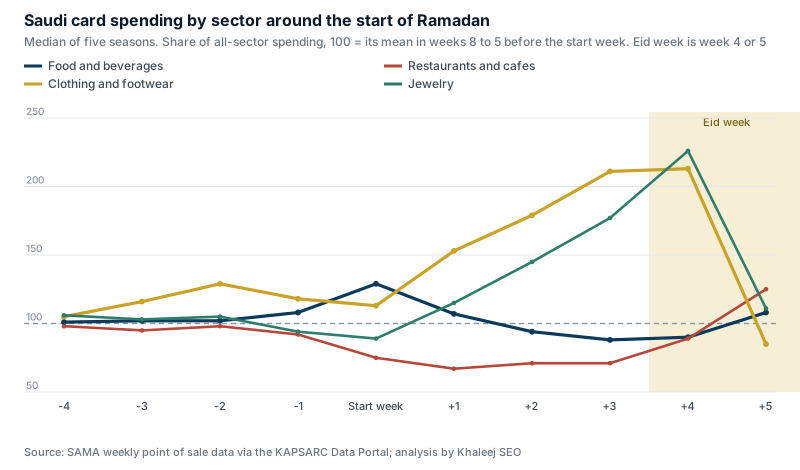
SAMA publishes the value of card payments at points of sale every week by sector. We took each sector’s share of all-sector spending, then divided it by the sector’s average share in the weeks 8 to 5 before the day-one week (index 100), to remove the pay-cycle swings that move every sector together. The chart shows the median of five seasons.
| Sector | When it peaks | Index at the peak | Other readings |
|---|---|---|---|
| Food and beverages | Start week (5 of 5 seasons) | 129 (120 to 133) | 88 (80 to 94) three weeks later |
| Restaurants and cafes | Lowest in weeks 0 to +4 | 62 to 70 at the low | 126 in the Eid week (89 to 145) |
| Clothing and footwear | Week before the Eid week (5 of 5) | 248 (191 to 273) | 206 two weeks before Eid week; 83 the week after |
| Jewelry | Week before the Eid week (3) or the Eid week (2) | 226 (201 to 231) | Peak value in each of the five seasons |
The Eid week falls in week +4 or +5 after the start, so the chart blends two Eid weeks. The table counts from the Eid week itself, which is why its clothing and jewelry figures are higher than the chart’s.
Put side by side, three clocks run in one month:
- At the start. Searches for offers peak and the food share of card spending peaks in the same weeks.
- Just before day one. Decorations peak in week 0, and in the week before in three of 25 seasons.
- At the end. Searches for Eid gifts, and the clothing and jewelry shares of card spending, peak in the last two weeks.
The card series is not a measure of sales: it counts payments at points of sale, so online orders are not in it. Searches and spending also do not move in lockstep: clothing spending reached its peak three to four weeks after searches for offers did.
A fading peak in two markets
The search index is scaled to the highest point in each country, so the peak itself can be compared across the five seasons.
| Peak of «عروض رمضان» (index) | 2022 | 2023 | 2024 | 2025 | 2026 |
|---|---|---|---|---|---|
| Saudi Arabia | 100 | 79 | 65 | 55 | 43 |
| Oman | 80 | 72 | 54 | 52 | 44 |
| United Arab Emirates | 100 | 80 | 56 | 75 | 55 |
| Kuwait | 53 | 63 | 53 | 59 | 51 |
In Saudi Arabia and Oman the peak was lower in every season than in the one before; in the UAE, Kuwait and Qatar it was not. We do not know why. The index is a share of Google searches, not a count of shoppers, so it can fall when more shopping moves to apps, marketplaces and AI assistants, or when people switch phrases, and Google also removes searches made through AI Mode and AI Overviews from Trends. Treat it as a reason to watch your own Search Console data, not as a forecast.
Ramadan 2027: the weeks to plan around
This table applies the Saudi medians above to the expected 2027 dates. It is our calculation, and it moves if the moon sighting moves Ramadan.
| Week starting (Sunday) | Week | What the data says |
|---|---|---|
| 10 January 2027 | -4 | Searches about 9% of the peak |
| 17 January | -3 | Searches at 10% of the peak or more in all five seasons (median 16%) |
| 24 January | -2 | Median 34%; in 2026 the official discount season opened in this week of the count |
| 31 January | -1 | Median 48% |
| 7 February | 0, day-one week (expected Monday 8 February) | Searches near the peak (median 99%); decorations and food spending peak |
| 14 February | +1 | The highest median week for searches |
| 21 February | Eid week -2 | Clothing share median 206 |
| 28 February | Eid week -1 | Clothing and jewelry spending peak; Eid gift searches peak |
| 7 March | Eid week (Eid expected Wednesday 10 March) | Restaurants return (median 126) |
What this means for SEO
This section is our analysis, not a source figure.
- Be indexed by the third week before day one, not by Ramadan. For 2027 that is the week of 17 January. A page that starts to rank in the day-one week misses a median 26% of the interest. Google’s own advice for sales-event pages is to create the page early so it can be indexed.
- Use both words. Shoppers type «عروض رمضان»; the ministry’s season and the licence use «تخفيضات رمضان». One permanent page that carries both, with the licensed offers shown where a store has them, answers both.
- Plan three page types, not one. An offers page for the start week, a decorations and home page that is ready before day one, and gift, clothing and jewelry pages that peak in the last two weeks. Keep one address per page with no year in it and refresh the content each season.
- Match the budget to the category. Food retailers meet the peak in the start week. Fashion and jewelry stores meet theirs in the last two weeks, three to four weeks later. Restaurants should expect the Eid-week rebound. For the city view of the same weeks, see Saudi card spending by city: Makkah’s share of spending rises in Ramadan weeks while Riyadh and Khobar hold a smaller share.
- Move the dates every year. The month starts 10 to 12 days earlier on the calendar each year. Update titles, dates and internal links, but keep the URL and the links to it.
- Check your own category. Open Google Trends for your own product terms in Arabic and English with the five-year view, and compare it with your Search Console queries before you set dates.
If your season pages are not ready, our e-commerce SEO service covers season and category pages, and a free SEO audit shows what Google sees today. The same method for the other big peak is in White Friday statistics, the weekly spending context is in Saudi shopping seasons, and the plan for season pages is in White Friday SEO for stores. For gift and Eid pages in one category see jewellery store SEO in Saudi Arabia, and for the wider market see our SEO agency in Saudi Arabia page.
Methodology and sources
- Google Trends, trends.google.com, “Explore”, Web Search, all categories, past 5 years, weekly points, one country at a time (Saudi Arabia, United Arab Emirates, Kuwait, Qatar, Bahrain, Oman). Five search terms per country, not topics: «عروض رمضان», «تخفيضات رمضان», «زينة رمضان», «ملابس العيد» and «هدايا العيد». The five seasons are 2022 to 2026; Ramadan 2021 falls before the five-year window. Read on 27 October 2026, in the late morning, Cairo time. Bahrain was read and is in the CSV, but is not analysed because its weekly values switch between 0 and about 70 from one season to the next, which is low-volume rounding.
- What Google says about the data, Trends FAQ: it is a sample of searches; values are scaled from 0 to 100 against the highest point; terms with few searches show as 0; small random noise is added; and searches made by Google products such as AI Mode and AI Overviews are filtered out. We did not check any of this ourselves.
- Ramadan and Eid dates: timeanddate.com holiday pages for Saudi Arabia, “Ramadan begins” and “Eid al-Fitr”, opened on 27 October 2026. The 2027 dates are marked tentative there. Saudi Arabia confirms the month by moon sighting, so a day can differ. Ramadan began on a Saturday in 2022 and 2025, the last day of the Sunday to Saturday week; the headline count treats week 0 and week +1 together, so it does not depend on that day.
- SAMA, weekly point of sale data by sector, as republished by the KAPSARC Data Portal. Weeks to 6 July 2025 come from the earlier series and weeks from 29 June 2025 from the newer detailed series, which SAMA publishes with updated sector groups; the all-sector totals and the food series match across both. Clothing is “Clothing and Footwear” in the earlier series and “Apparel, Clothing and Accessories” in the newer one, so each season is indexed within its own series. The method for joining them is described in Saudi shopping seasons.
- Ministry of Commerce, news of 20 February 2024 and 28 January 2026 on the “Ramadan discounts” season, opened on mc.gov.sa on 27 October 2026.
- Google Search Central, Best practices for Black Friday and Cyber Monday pages, 26 October 2020: create the sales page early so it can be indexed.
- Our calculations: the day-one week and the Eid week, the median across five seasons, the share of each season’s peak, the 12-week window (week -8 to week +3), the share already over, and the sector share index. Values are rounded half up.
- Limits: the search values are an index, not a count, and a value of 50 means half of the highest point shown. A term is matched as typed, so other spellings are not counted. Low-volume terms show as 0, which is why we draw no conclusion about the early weeks outside Saudi Arabia and the UAE. The card data counts payments at points of sale in Saudi Arabia only and does not include online orders. We used no retailer announcements, paid datasets or survey claims.
Free downloads: ramadan-search-interest.csv holds the weekly values for every country, term and week from 12 weeks before to 8 weeks after the day-one week, for the five seasons. ramadan-card-spending-share.csv holds the weekly Saudi card spending by sector with each sector’s share and index. ramadan-summary.csv holds the peak weeks, the medians, the missed-share table, the phase shares and the 2027 weeks.
How to cite this page
Khaleej SEO, “Ramadan shopping statistics: Gulf searches peak in the first days, and Saudi clothing spending peaks the week before Eid”, khaleejseo.com/blog/ramadan-shopping-statistics/, updated 27 October 2026. Name Google Trends as the source of the index values and SAMA, through the KAPSARC Data Portal, as the source of the card data. The charts and the CSV files may be reused with this credit and a link.
Updates
- 27 October 2026: first published, with Google Trends read on this date and SAMA weekly data to 22 March 2026. We will confirm the 2027 dates after the moon sighting and add the ministry’s 2027 season dates when they are announced.
Arabic and English SEO specialists for e-commerce stores, dental clinics and travel companies. Our team has led SEO for some of the largest e-commerce brands in the Gulf, across 7 MENA markets.