White Friday statistics: Gulf searches peak in one week, and in Saudi Arabia 'black friday' beats the Arabic name
Five years of Google Trends data for Saudi Arabia, the UAE, Kuwait, Qatar, Bahrain and Oman, read next to SAMA's in-store and online card spending: when searches start, how fast they fall, which name people type, and what a late page misses.
 The Khaleej SEO team
Published · Updated · 9 min read
Key finding: In all six Gulf countries we checked, searches for “black friday” peak in the week that holds the Friday (29 of 30 country-years), and 70% to 82% of six weeks of interest falls in that week and the two before it. In Saudi Arabia the English phrase beats «الجمعة البيضاء» every year, by 8.3 to 1 in 2025.
This page reads Google Trends for Saudi Arabia, the United Arab Emirates, Kuwait, Qatar, Bahrain and Oman, then sets it beside two Saudi card-spending series from SAMA that we analysed in earlier posts. Trends gives an index, not a count of searches. The method section says what that allows and what it does not.
White Friday at a glance
| Figure | Value | Source and period |
|---|---|---|
| Peak week of “black friday” searches | The week with the Friday, in 29 of 30 country-years; Saudi Arabia in 2024 was one point lower (27 against 28) | Google Trends, 2021 to 2025 |
| Share of six weeks of interest in the sale week and the two weeks before | 70% to 82% in every country-year | Our calculation from Google Trends |
| Interest four weeks before the sale week | 10% to 21% of the sale-week level (median by country) | Google Trends, 2021 to 2025 |
| Interest one week after | 14% to 29% of the sale-week level | Google Trends, 2021 to 2025 |
| Saudi Arabia, sale-week index, “black friday” against «الجمعة البيضاء» | 100 against 12 in 2025; 31 against 18 in 2021 | Google Trends |
| Saudi in-store card spending, all sectors, White Friday week against the 4 weeks before | +9.2% in 2025; between -8.6% and +9.2% in 2020 to 2025 | SAMA weekly data, our analysis |
| Saudi mada online spending, November against October | -5.3% in 2025; +16.5% in 2019 | SAMA monthly data, our analysis |
When the searches happen
We call the Sunday to Saturday week that holds the Friday after the fourth Thursday of November the sale week. The Fridays were 26 November 2021, 25 November 2022, 24 November 2023, 29 November 2024 and 28 November 2025. In 2026 it is Friday 27 November, so the sale week runs from Sunday 22 to Saturday 28 November. Retailers start offers on their own dates, often earlier, and we did not check them. Searches show when shoppers look.
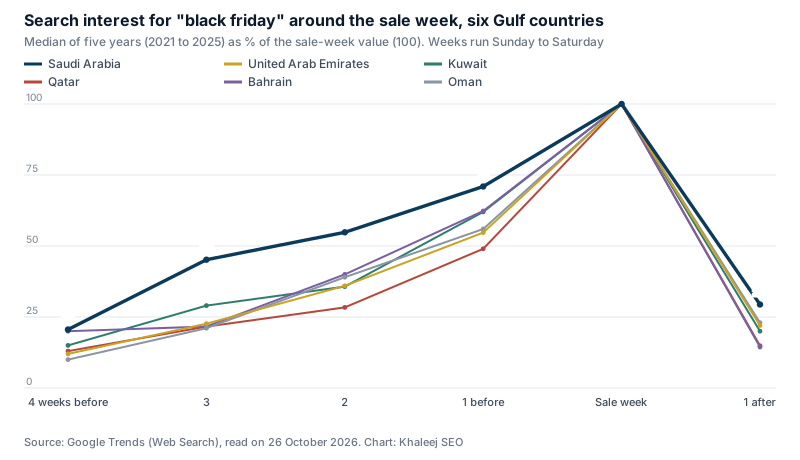
| Country | 4 weeks before | 2 weeks before | 1 week after |
|---|---|---|---|
| Saudi Arabia | 21 | 55 | 29 |
| United Arab Emirates | 12 | 36 | 22 |
| Kuwait | 15 | 36 | 20 |
| Qatar | 13 | 28 | 15 |
| Bahrain | 20 | 40 | 14 |
| Oman | 10 | 39 | 23 |
Each figure is the median of five years, with the sale week as 100. Three weeks before and one week before are in the summary CSV. For Saudi Arabia the weeks run 21, 45, 55 and 71 before the sale week.
Interest is not spread over the month. Take the six weeks from four weeks before the sale week to one week after. In each of the 30 country-years, 70% to 82% of that interest fell in the sale week and the two weeks before it. The week after is the sharpest drop: interest was down to 14% to 29% of the peak within seven days.
What a page that ranks late misses
A page that starts to rank in a later week misses the searches that already happened. We counted, for each of the 30 country-years, the share of the six weeks that was over before each week began.
| Your page starts to rank | In 2026 | Share of the six weeks already over |
|---|---|---|
| 3 weeks before the sale week | 1 November | 6% (3% to 11%) |
| 2 weeks before | 8 November | 16% (10% to 25%) |
| 1 week before | 15 November | 30% (20% to 42%) |
| In the sale week | 22 November | 53% (38% to 67%) |
Each figure is the median, with the lowest and highest country-year in brackets. The six weeks start on 25 October in 2026, and earlier weeks held small values too (in Saudi Arabia in 2025 the two weeks before the six-week window were 6 and 4, against 100 in the sale week). Google’s own advice for sale pages, in its Search Central post of 26 October 2020, is to publish the page well before the sale so Googlebot can find and index it. Our White Friday SEO plan has the six-week timeline.
What people type
Trends matches the words of a search term, not other spellings. We compared five terms in each country: “black friday”, “white friday”, «الجمعة البيضاء», «بلاك فرايدي» (Black Friday in Arabic letters) and «الجمعة السوداء» (the Black Friday name in Arabic). All five sit on one scale, where 100 is the highest weekly value of any of them in that country over the five years.
| Year | “black friday” | الجمعة البيضاء | Ratio |
|---|---|---|---|
| 2021 | 31 | 18 | 1.7 to 1 |
| 2022 | 25 | 11 | 2.3 to 1 |
| 2023 | 34 | 19 | 1.8 to 1 |
| 2024 | 27 | 12 | 2.3 to 1 |
| 2025 | 100 | 12 | 8.3 to 1 |
The table is Saudi Arabia in the sale week of each year. The English phrase was ahead in all five years, and its share of the five terms went from 44% in 2021 to 79% in 2025, while the Arabic White Friday name went from 26% to 10%. Most of that shift came in 2025: from 2022 to 2024 the English share stayed between 49% and 55%.
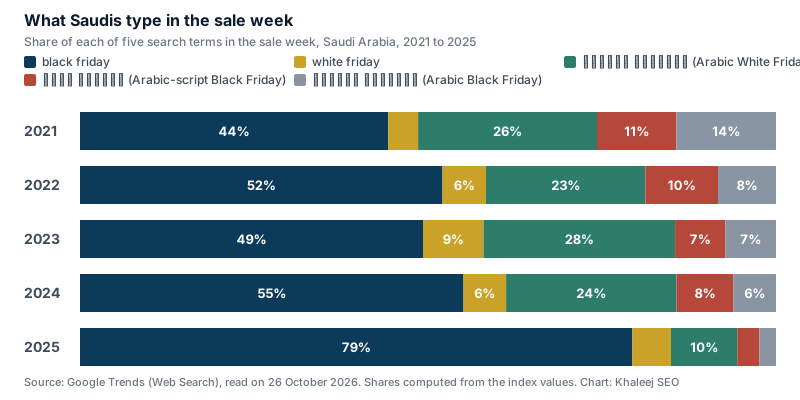
Two more numbers belong to this chart. In 2025 the sale-week index of “black friday” in Saudi Arabia was 2.9 times its 2023 level, the previous highest. The Arabic name moved the other way: in a separate series for that term alone, its 2025 peak was 37% below its 2023 peak (63 against 100). Nothing here says why, and a search term is not a shopper’s preferred name for the sale.
The UAE looks different. In the sale week “black friday” took 78% to 90% of the five terms, “white friday” 9% to 19%, and each of the three Arabic names 2% or less. A separate comparison showed that “yellow friday” and its Arabic name never passed 2. In Kuwait, Qatar, Bahrain and Oman, Google shows terms with few searches as 0, so the Arabic names mostly read 0 and we make no claim about them. Qatar is the one of the four where “white friday” shows clearly: 15, 16 and 23 in 2023, 2024 and 2025, against 75, 74 and 100 for “black friday”.
Searches, store spending and online spending
We have analysed two SAMA series in earlier posts: weekly card payments at points of sale (Saudi shopping seasons) and monthly mada online sales (Saudi e-commerce statistics). Side by side with the search index for the same years:
| Year | Searches, “black friday” in Saudi Arabia (index) | In-store, all sectors, White Friday week against 4 weeks before | Online mada, November against October |
|---|---|---|---|
| 2021 | 31 | -0.8% | +7.7% |
| 2022 | 25 | -8.6% | +3.0% |
| 2023 | 34 | -6.0% | +0.5% |
| 2024 | 27 | +7.5% | -4.9% |
| 2025 | 100 | +9.2% | -5.3% |
Searches have a sharp one-week peak every year. Card spending does not follow the same shape. In-store totals rose from 2022 to 2025 while the online mada November result fell, and the jump in searches in 2025, from an index of 27 to 100, came with a November that was 5.3% below October. We make no causal claim. The weekly series counts card payments in stores, mada is a debit network, and the search series is an index, so none of the three is a full measure of White Friday. The finding is that attention and spending peak in different ways.
What this means for SEO
This section is our analysis, not a source figure.
- Be indexed before the ramp, not for the Friday. A page that starts to rank in the sale week misses a median 53% of the six weeks. In 2026 the sale week begins on 22 November, so the third week before it begins on 1 November. New URLs can take days or weeks to appear.
- Cover the English phrase and the Arabic names on the same page. In Saudi Arabia “black friday” was ahead of «الجمعة البيضاء» in every year, so a page that names only one of them leaves part of the searches unanswered. One permanent page, with no year in the address, is easier to keep strong than a new page each season.
- Judge the season by the week, not the month. A three-week event disappears in a monthly report. Use weekly Search Console data for your own pages, and do not use November online card spending as the yardstick: in SAMA’s mada series December has been the bigger month in most years (see Saudi e-commerce statistics).
- Plan categories by channel. In stores, clothing rose in White Friday week in every year since 2020, while electronics never rose by more than 4.0%; shoppers who compare electronics prices may do it online, which the weekly series cannot show. The detail is in our seasonal card data.
- Keep the page after the sale. Interest falls to 14% to 29% within a week, but the same address gets the next ramp. Update it, keep the links to it, and do not delete it.
- Check your own category. Open Google Trends for your own product terms, in Arabic and in English, with the five-year view, and compare it with your Search Console queries before you set dates.
If your store pages are not yet ready, our e-commerce SEO service covers season and category pages, and a free SEO audit shows what Google sees today. For the wider market see our SEO agency in Saudi Arabia page, and if your pages are not appearing yet, read store not showing on Google. The same timing method applied to Ramadan is in Ramadan shopping statistics.
Methodology and sources
- Google Trends, trends.google.com, “Explore”, Web Search, all categories, past 5 years, weekly points, one country at a time (Saudi Arabia, United Arab Emirates, Kuwait, Qatar, Bahrain, Oman). Five search terms per country, not topics: “black friday”, “white friday”, «الجمعة البيضاء», «بلاك فرايدي», «الجمعة السوداء». A separate Saudi series for «الجمعة البيضاء» alone and a UAE comparison with “yellow friday” and «الجمعة الصفراء» were also read. Read on 26 October 2026, in the late morning, Cairo time. Saudi Arabia and the UAE were loaded more than once with different companion terms, and the shared terms matched in the weeks we compared. The current week is partial, so the CSV stops the 2026 rows at 18 October.
- What Google says about the data, Trends FAQ: it is a sample of searches; values are scaled from 0 to 100 against the highest point; terms with few searches show as 0; small random noise is added, most visible for low-volume terms; and searches made by Google products such as AI Mode and AI Overviews are filtered out. We did not check any of this ourselves.
- Google Search Central, Best practices for Black Friday and Cyber Monday pages, 26 October 2020: create the sales page early so it can be indexed, and link to it from the home page.
- SAMA, weekly point of sale data and monthly mada e-commerce data, as republished by KAPSARC and analysed in Saudi shopping seasons and Saudi e-commerce statistics; the figures here are copied from those pages and use the same sale-week definition.
- Our calculations: the sale week, the median across 2021 to 2025, the six-week window (four weeks before to one week after), the share of that window already over, and the term shares. Shares use the index values of the sale week and are rounded half up.
- Limits: the values are an index, not a count, and a value of 50 means half of the highest point shown. A search term is matched as typed, so other spellings are not counted. “black friday” in English also catches searches about global sales and people checking the date. Low-volume terms show as 0, which is why we draw no conclusion about Arabic names outside Saudi Arabia and the UAE. We did not use retailer announcements, paid datasets or survey claims.
Free downloads: white-friday-search-interest.csv holds the weekly values for every country, term and week from late September to early December (2021 to 2025, and 2026 to 18 October), with the weeks counted from the sale week. white-friday-search-summary.csv holds the medians, the window shares, the term shares and the missed-share table.
How to cite this page
Khaleej SEO, “White Friday statistics: Gulf searches peak in one week, and in Saudi Arabia ‘black friday’ beats the Arabic name”, khaleejseo.com/blog/white-friday-statistics/, updated 26 October 2026. Name Google Trends as the source of the index values. The charts and both CSV files may be reused with this credit and a link.
Updates
- 26 October 2026: first published, with Google Trends read on this date and SAMA figures as in our two earlier posts. We will add the 2026 weeks after the sale week of 22 to 28 November 2026, and update the SAMA rows when SAMA’s archive adds the next figures.
Arabic and English SEO specialists for e-commerce stores, dental clinics and travel companies. Our team has led SEO for some of the largest e-commerce brands in the Gulf, across 7 MENA markets.